Learn my secrets to creating a successful online business with my holistic strategies and soulful marketing advice for heart-centered entrepreneurs who value relationships, mindfulness, spirituality and health as much as strategic action and practical tips.
LEARN MORE →




Success with Soul Incubator
Success with Soul Shop
Launch Your Dream Offer Mini Course

Our most popular posts to help you create, grow and monetize your online business with soul!
EXPLORE POSTS →
Income Reports
Passive Income
Increasing Traffic


Every online business income report I’ve published since 2017, with real revenue, profit margins and lessons from growing a business without social media.
Last updated: October 28, 2026
Last 12 months (Oct 2025–Sept 2026): $974,208 in revenue at a 55.9% profit margin, after ads, contractors and partner commissions, before taxes and my own pay.
Table of Contents
What Are My Online Business Income Reports?
My online business income reports are breakdowns of exactly what Success with Soul earns and spends each month, including revenue, profit after ads, contractors and partner commissions, what drove the numbers and what flopped. I’ve published them since 2017, from my food and wellness blogging days to the social-free education business I run now.
Think of this page as the table of contents for all of it (the good months, the humbling ones and the ones where I had to correct my own math). New here? Start with the newest report above, then scroll down for the full archive by year.

How Has My Online Business Grown Since 2015?
My business grew from a food and wellness blog that made $6,500 in its first year into Success with Soul, a social-free education business that has made over $2.5 million since I quit social media in 2021. It was not a straight line, and the reports below show the dips as clearly as the jumps.
I was a freelance journalist when I started Root + Revel at the end of 2015, and I went full-time on it in 2017. I launched Success with Soul in 2019 to teach what I’d learned. That October, I lost over $12,000 on my first course launch and a bad Facebook ads bet. My next launch, three months later, made over $100,000 in two weeks.
In 2021 I sold Root + Revel for multiple six figures, and that November I deleted every social app in one night over Thanksgiving, planning to take a break until New Year’s. I never went back, and the business grew 165% in my first social-free year.
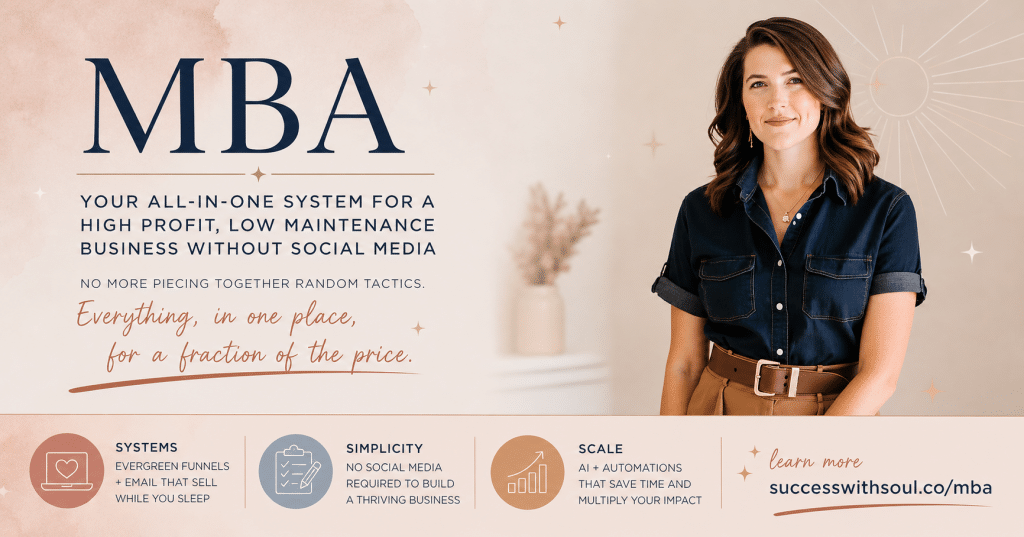
Then came 2023, my worst year in business. I was carrying a high payroll, taking on debt to cover it, and my $10,000 group program stopped selling. So I broke that one big program into smaller, cheaper offers and bundled all of them into Mindful Business Academy, which is still the backbone of the business.
In 2024 I took a six-month sabbatical, then started The Room and The $1k/Day Experiment. In 2025, my first year without employees, I restarted paid ads (they lost money for six months before they worked) and quadrupled my daily revenue. In 2026, JV webinars (live classes I teach to a partner’s email list, splitting the revenue) helped carry me past my $500,000 goal before July ended.
| Year | What happened | Read the report |
|---|---|---|
| 2016 | $6,500 in my first year of blogging | (before the reports started) |
| 2017 | $75,000 in my first full-time year | 2017 income report |
| 2018 | $150,000, with four months of maternity leave | 2018 income report |
| 2019 | $194,500+ from my blog, plus a course launch that lost money | 2019 year in review |
| 2020 | My first six-figure month, then $135,000+ during a four-month maternity leave, mostly from evergreen funnels | Paid maternity leave report |
| 2021 | Sold Root + Revel for multiple six figures and quit social media | How I sold my blog |
| 2022 | Grew 165% in my first year without social media | How I quit social media |
| 2023 | My worst year, which led to Mindful Business Academy | (no reports that year) |
| 2024 | $67,000+ from evergreen sales during a six-month sabbatical | Sabbatical report |
| 2025 | Quadrupled my daily revenue as a solo business owner | How I quadrupled daily revenue |
| 2026 | Passed my $500,000 goal before July ended, with help from four JV webinars | Spring + Summer 2026 report |
Why Do I Share My Income So Publicly?
I share my income because transparency is my #1 core value, and because the full picture is more useful to you than a highlight reel. A revenue number on its own tells you almost nothing. What made it, what it cost and what went wrong are the parts you can use.
So every report tries to show the whole machine. That means gross revenue and profit side by side, the ads, contractors and partner commissions it took to get there, and who did the work (these days that’s me, Rachel, my operations director, and a lot of AI). When a big month came from one unusual launch or partnership, I say so in the same breath.
It also means the misses. You’ll find the $12,000 launch that flopped, the six months of ads that lost money, my lowest revenue week on record and a correction when my own numbers were wrong. I’m proud of what this business has become, and I’d rather own that calmly than act surprised by it.
Reading other people’s income reports is what convinced me an online business could be a real business back when I was a skeptical journalist. If mine help you see what’s possible, what it takes and what you’d do differently, they’re doing their job. They also keep me honest, because writing them forces me to look at my own numbers every month.

How Do I Market My Business Without Social Media?
I market my business with an email list, search content, partnerships and a little paid advertising, and I haven’t posted organically on social media since November 2021. My email list does most of the selling. Everything else exists to get new people onto it.
Organic social media has become a pay-to-play channel. Facebook’s average organic reach fell from 16% in 2012 to about 1–2% in 2025, according to Hootsuite, and Instagram’s organic reach dropped another 12% from 2024 to 2025. As I like to remind people, Instagram exists to grow Instagram’s business, and yours is an afterthought.
My weekly revenue routine
Once the automations are built, my week comes down to four marketing moves, and they take a few hours.
- Send one sales email to my list, because your email list is the only audience you truly own.
- Get in front of one new audience with a guest podcast, a bundle or summit, an email swap, a sponsored newsletter spot, a JV webinar or a paid ad. Social-Free Visibility covers the pitching side.
- Publish one piece of search content, like a blog post, YouTube video, podcast episode or Pinterest pin (yes, Pinterest is a search engine). Anti-Social SEO + GEO teaches how to get found on Google and cited by AI tools like ChatGPT.
- Build or tweak one automation, so new subscribers keep buying without me. Scale Smart with AI and Evergreen Ecosystem show you how to build them.
Those automations form what I call a flywheel. A new subscriber gets a small, discounted offer right away, then emails that help them get a result, then a chance to join a membership, and eventually an invitation to become an affiliate who sends new people in. Evergreen Ecosystem walks through the whole setup.
One more piece matters if you’re leaving social media. Leave up a static nine-post grid that tells visitors where to find you, so a curious stranger doesn’t assume you went out of business.
How Do Online Businesses Make Money?
Most online businesses make money through four revenue streams, whether or not they use social media: display ads, sponsorships, affiliate marketing and their own digital products. I’ve used all four, and my own digital products have made me the most money by far, because I keep the whole sale and don’t need huge traffic.
| Revenue stream | How you get paid | Traffic needed | How passive is it? |
|---|---|---|---|
| Display ads | Ad networks pay you per visitor | A lot | Very |
| Sponsorships | Brands pay a fixed fee up front | Some (an engaged email list counts) | Not very |
| Affiliate marketing | A commission when someone buys through your link | Any | Fairly |
| Your own digital products | You keep 100% of every sale | Much less | Very, once your funnels are built |
1. Display ads
Display ads pay you for traffic, and you can start with Google AdSense at any size. As your traffic grows, premium networks like Mediavine and Raptive (formerly AdThrive, which I used for Root + Revel) pay much better, so check their current traffic minimums before you apply.
At Root + Revel, ads brought in about $3,000 to $5,000 a month once the blog hit 150,000 monthly pageviews. They need a lot of traffic, pay less than other options, and distract from what I want visitors to do, which is to join my email list. That’s why Success with Soul has no display ads.
2. Sponsorships
Sponsorships pay you a guaranteed, upfront fee to feature a brand you believe in. I’ve negotiated $2,000+ deals for a single blog post, and these days brands sponsor my newsletter instead, which works even with a small list.
Sponsorships take active pitching and relationship building, so they’re the least passive option. My guide to getting sponsored walks through how to land your first deal.
3. Affiliate marketing
Affiliate marketing pays you a commission when someone buys a product through your unique link, and you can start with zero traffic. Affiliate commissions brought in about $45,000 for my business in 2025, mostly from tools and courses I use every day.
The downsides are that commission rates can change without notice and you’re sending readers to someone else’s site. These 10 affiliate marketing tips will help you earn more from it.
4. Your own digital products and services (my #1 revenue stream)
Selling your own digital products is my favorite way to make money online, because you keep 100% of the sale and need far fewer visitors to earn the same amount. Mindful Business Academy alone brought in about $122,000 in 2025, and a big share of it came in through automated funnels rather than live launches.
Products take more time up front, and you may need new skills like course creation and sales. If you’re still figuring out what to sell, Instant Income walks you through creating and pre-selling an offer.

Every Online Business Income Report, Newest First
Here is every income report I’ve published about my own businesses, grouped by year.
2026 Income Reports
- September 2026 Income Report: My Digital Product Income
- August 2026 Income Report: $128K + My First AI Virtual Event
- Spring + Summer Income Report: Joint Venture Webinar Edition
- My Evergreen Online Business Made $37,544: March 2026 Income Report
- February 2026 Income Report: What My Business Earns Without Launching (Even When I’m Grieving)
- January 2026 Income Report: What My Passive Income Online Business Earns on Autopilot
2025 Income Reports
- December 2025: How I Made $85k in My ‘Slow’ Month
- September – November 2025 Income Report: 77% Profit Margin
- August 2025 Income Report: How to Scale Online Business Profitably
- July 2025 Income Report: Strategic Business Investments + Spending to Scale
- June 2025 Income Report: Deep Work + Delegation as an Introverted Entrepreneur
- May 2025 Income Report: The Systems That Scaled My Biz to 365 Days of Daily Sales
- April 2025 Income Report: $19,812.41 as a Neurodivergent Entrepreneur with OCD
- March 2025 Income Report: $18,921 While Balancing Family and Business Growth
- February 2025 Income Report: Making Money While Taking Time Off
- January 2025 Income Report: Passive Income for A Slow, Sustainable Start to the Year
2024 Income Reports
- December 2024 Income Report: Rest as a Revenue Strategy
- November 2024 Income Report: $27,000 + Lessons in Values-Driven Entrepreneurship
- October 2024 Income Report: $31,000+ in Passive Income Without Social Media
- How I Took a 6-Month Business Sabbatical—And Made $67K+ Without Trying
2020 Income Reports
- Paid Maternity Leave: How I Made $135,000+ in 4 months in 2020
- Lifestyle Blog Income Report for March 2020: $23,491+
- Blog Income Report for February 2020: $23,000+
- Six-Figure Blog Academy Launch Debrief: How I Made $142,915 From My Online Course
- Online Business Income Report: My First Six-Figure Month!
2019 Blog Income Reports
- Year in Review: How I Made $194,500+ From My Blog
- Blog Income Report: $18,033.67 in December 2019
- Blog Income Report: $19,401.01 in November 2019
- Blog Income Report: $15,167.70 in October 2019
- Q3 Income Report: When Things Don’t Go As Planned
- Q2 2019 Income Report: $40,409.69
- My March 2019 Income Report: $16,296.14
- My February 2019 Monthly Income Report: $11,271.39
- My January 2019 Monthly Income Report: $20,764.65
2017–2018 Blog Income Reports
- 2018 Income Report: HOW I MADE $150,000 BLOGGING IN YEAR 3
- How I Made $58,000 While On Maternity Leave: A Q4 Income Report
- My August 2018 Monthly Income Report: $15,753.29
- My July 2018 Monthly Income Report: $13,729.67
- My June 2018 Monthly Income Report: $13,560.73
- My May 2018 Monthly Income Report: $13,143.92
- My April 2018 Monthly Income Report: $8,276.08
- My March 2018 Monthly Income Report: $9,214.45
- My February 2018 Monthly Income Report: $10,243.05
- My January 2018 Monthly Income Report: $7,522.62
- Income Report: How I Made $75,000 Blogging in Year 2
Case Study: Rachel’s Seeds & Stalks Progress Reports (2024)
In 2024, Rachel, my operations director, built her herbalist coaching business, Seeds & Stalks, from scratch without social media, and shared her progress here. These reports follow her business, not mine.
- September 2024 Progress Report: 6 Months to a Profitable Online Business
- Summer 2024 Progress Report: How to Navigate Summer Work Schedules with Kids at Home
- June 2024 Progress Report: You Can Do Hard Things
- May 2024 Progress Report: Make Money from Email Marketing
- April 2024 Progress Report: email list growth strategies for newbies
- March 2024 Progress Report: starting a business without social media
FAQs About My Online Business Income Reports
How much has Kate Kordsmeier’s online business made?
My online business has made over $2.5 million since I quit social media in November 2021. My most recent 12-month revenue and profit margin are listed at the top of my income reports page, next to the newest report.
Why do online business owners publish income reports?
I publish income reports to show the full picture of how an online business makes money, including the costs, the people involved and the months that flop. They keep me honest and give other entrepreneurs a real example to learn from instead of a highlight reel.
Can you make money online without social media?
Yes. I haven’t posted organically on social media since November 2021. My business grows through an email list, search content for Google and AI tools, partnerships like guest podcasts and JV webinars, and a small amount of paid advertising.
What is the best way to monetize a blog or online business?
Selling your own digital products is the most profitable option for most small businesses, because you keep the whole sale and don’t need huge traffic. Display ads, sponsorships and affiliate marketing can add income on top, but they depend more on audience size.
How often does Kate Kordsmeier publish income reports?
I aim to publish an income report every month. Some reports cover a few months at once, like my Spring + Summer 2026 report on four JV webinars. The newest report is always linked at the top of my income reports page.
Want the Behind-the-Scenes Version?
These income reports are the public version. Inside The $1k/Day Experiment, members get my weekly diaries, the dashboards I use to make decisions, full debriefs of every launch and experiment, and live office hours. It’s $197 a year (or $27 a month).

More ways to work with me
- Mindful Business Academy gives you every course, AI tool and template I sell in one place, with lifetime access.
- The Room is my mastermind for doers, with weekly group coaching, monthly Get It Done Weeks and direct access to me ($997 a year or $197 a month).
Free resources to get started
- The Daily Sales Playbook is the exact daily checklist I use to make sales without social media, even when I’m not actively selling.
- The Beyond the Scroll Challenge shows you how to grow your business without posting.
