Learn my secrets to creating a successful online business with my holistic strategies and soulful marketing advice for heart-centered entrepreneurs who value relationships, mindfulness, spirituality and health as much as strategic action and practical tips.
LEARN MORE →




Success with Soul Incubator
Success with Soul Shop
Launch Your Dream Offer Mini Course

Our most popular posts to help you create, grow and monetize your online business with soul!
EXPLORE POSTS →
Income Reports
Passive Income
Increasing Traffic







Last Updated on June 30, 2026
Thinking “my husband doesn’t support my business”? You don’t need his permission to back yourself, and yes, it takes money to make money. Here’s how to decide.

A woman in my world said this to me recently, almost word for word:
“I love the system. I believe the flywheel will spin for me. I’m just not sure about signing up, because my husband will complain that I’m spending money and not making any yet.” Then she added the line that gave the whole thing away: “It’s very hard for him to understand. You can’t do the online world on your own steam.”
If your husband doesn’t support your business, or doesn’t understand it, or quietly suspects your investment is money lit on fire, you know this exact knot.
(I’m saying “husband” because that’s usually who’s in the room, but swap in wife, partner, spouse, parents, friends, or whoever you’ve been waiting on for a thumbs-up.)
Most women come looking for a better argument, the magic set of words that will finally make him get it.
I’m going to disappoint you and then, I hope, relieve you. There is no such argument. You will not talk him into belief.
You back yourself first, you let the results talk, and his understanding shows up later, if it ever does. And the spending part you’re bracing for? It takes money to make money. Every business that has ever existed runs on that math.
Money is loaded between couples to begin with. 56% of couples argue about it more than any other topic (American Association of Marriage and Family Therapy, 2024).
So your nerves make sense. Let’s separate what’s his to weigh in on from what was always yours to decide.
Prefer to listen?
I first answered this out loud in a pop-up Voxer channel, voice memo and all. If you’d rather hear me talk it through than read it, the original audio lives here.
Table of Contents
Why doesn’t my husband support my business?
Your husband probably doesn’t support your business because he can’t see the industry you’re standing in. He sees money going out and nothing coming back yet.
From his seat, you’re spending and not earning, and that’s the kind of thing partners complain about. It usually comes from love and fear, not control or disrespect.
He’s also working from a myth, the same one the woman above named so well: that you can build an online business on your own steam, for free, if you just try hard enough. You can’t. Nobody can create something out of nothing with nothing.
There’s an entire world of tools, education, and strategy underneath this that he will never see, the same way I’ll never fully understand my husband’s commercial real estate deals. Whole industries run on machinery the outside person never clocks.
So before you cast him as the villain, give him a little grace. He’s reacting to the only data he has, which is the bank balance.
That doesn’t make him right. It makes him uninformed, which is a fixable problem and not a moral failing.
You can’t convince your husband with a better argument
You will not convince your husband by explaining funnels more clearly. Results convince people. Conversations almost never do.
The most successful women I know built the whole thing while their partner was skeptical, and the buy-in arrived after the money did, not before.
This is the part that surprises people, and the part that lets you off the hook. You can stop auditioning. You can stop assembling the perfect slide deck to win the household debate.
The job was never to make him believe. The job is to go do the thing and let the proof speak in a language he already understands: money in the account.

When I quit a stable corporate job in the middle of a recession to become a freelance journalist, exactly one person believed it would work: me. Everyone else thought I’d lost it. (“Freelance writing? That sounds fake” was said to my face.)
My in-laws eventually called to admit they’d been wrong about me. The results changed their minds. My certainty came first, alone, with no applause.
Self-belief is the prerequisite, not the prize you get at the end.
Believe in yourself before you ask anyone else to
Before your husband can believe in your business, you have to. Self-belief is the prerequisite, not the prize you get at the end.
You cannot sell someone conviction you don’t have, and a half-hearted “I think I might try this, but I’m scared and I might quit” is almost impossible to fund, his money or yours.
So the honest gut check is about you, not him. “I’m doing this until it works” is a completely different posture than “I kind of want to try.”
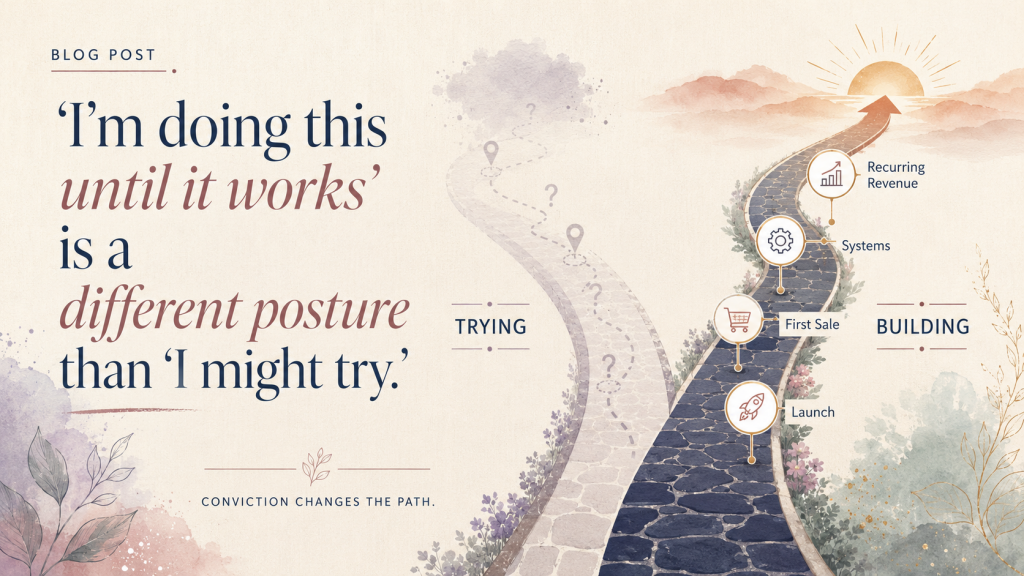
One of those reorganizes your whole life around making it true. The other folds the first time it gets hard.
And women hesitate here more than the data says we should. Women tend to earn better investment returns than men yet are less likely to invest at all, with 38% pointing to a lack of financial confidence (Global Financial Literacy Excellence Center, 2025).
That gap is about permission. We’re plenty capable. If your inner critic is louder than your conviction, taming imposter syndrome comes before any conversation with your husband, and the way old core beliefs quietly run the show is worth understanding before you blame the decision itself.
You don’t need a man’s permission to invest in your own work
You do not need a man’s permission to spend money on your own business. If part of you feels like you do, that’s not a personal flaw. It’s inherited.

Until the Equal Credit Opportunity Act of 1974, a married woman in the U.S. often couldn’t get a credit card or a loan without a man co-signing for her. That was the law, within living memory.
The law changed. The conditioning didn’t fully follow.
Asking your husband to sign off before you invest in your own work is a faint, well-mannered echo of needing a man’s signature on your money. You can feel the pull of it and still decline to obey it.
To be clear, I’m not telling you to go around him or hide a purchase. Secrecy isn’t independence, and it’ll cost you far more than any course.
There’s a real difference between informing your partner as an equal and asking him for a hall pass:
| Asking permission | Deciding as an equal |
|---|---|
| “Is it okay if I buy this?” | “I’ve decided to invest in this. Here’s the cost.” |
| His doubt becomes a veto | His doubt becomes information you both hold |
| You wait for him to understand first | You move, and understanding follows the results |
| The call is his to approve | The call is yours to own |
You get to choose which conversation you’re having.
One of them is partnership. The other is subservience with better manners.
Does it really take money to make money?
Yes. It’s arithmetic, the same for every business that has ever existed. Every business in every industry carries a cost to get going.
The average U.S. small business spends around $40,000 in its first year, and nearly two-thirds of founders cover it from personal or family savings (Shopify, 2025). Online businesses run far leaner, but “leaner” never meant “free.”
We argue our way out of this with “but it’s just me, I’m a solopreneur.” True, and that’s the good news. Your overhead is a laptop and some software.
You still pay something to build something out of nothing. We’ll drop six figures on a college degree that guarantees nothing but a diploma (and a decent story about a study-abroad semester), then flinch at investing in the actual skill of running a business.

You want to learn piano, you hire a teacher. Almost nobody sits down cold and figures it out.
The investment doesn’t have to be any particular thing. A course, a coach, a better tool, a few dollars a day in ads, a mentor who’s two steps ahead.
What matters is choosing investments with quick feedback loops, so money starts coming back while you’re still learning, instead of disappearing into a year-long void. That’s also how you stop the spending from looking reckless, to him and to you.
Money treated as fuel for growth behaves differently than money treated as a gamble, and most of the stories we tell ourselves about it are just old limiting beliefs in a trench coat.
FAQs: When Your Husband Doesn’t Support Your Business
How do I convince my husband to support my business?
Mostly, you don’t, at least not with words. Make a clear decision, invite his concerns once, then back yourself and let early results do the convincing. Most partners come around after they see money move, not after a perfect speech.
Is it wrong to invest in my business if my husband disagrees?
Hiding a purchase is a problem. Making a decision about your own work is not. Aim for an honest conversation between equals where you inform rather than ask permission. You can love your spouse deeply and still own your own call.
Does it really take money to make money in an online business?
Mostly yes, though far less than offline. Online businesses can start near $1,000, but they still need tools, education, and usually ad spend. Choose investments that pay back quickly so revenue comes in while costs go out.
Why do I feel like I need permission to spend money on myself?
Partly conditioning. Until the Equal Credit Opportunity Act of 1974, many married women couldn’t get credit without a man co-signing. The instinct to seek a man’s sign-off on money is old and learned, and you’re allowed to put it down.
You already believe the system works. The work is believing in you.
If “my husband doesn’t support my business” has been the loop running in your head, you came here for a way to get him on board. The honest answer is quieter and a little more radical.
You go first. You decide, you invest, you back yourself before anyone in your house claps for you. The flywheel spins for the woman who was already sure it would.
His belief is not the thing standing between you and your business. Your own is. And you don’t need his permission, or anyone’s, to start.
If you want to do the backing-yourself part alongside other women doing the exact same thing, that’s what The Room is for. It’s a membership full of people who stopped waiting for a thumbs-up and decided to bet on themselves with some company along the way.





FEELING OVERWHELMED?
There’s only one way to eat an elephant (hint: one bite at a time!) and our 30-step roadmap to starting an online business will help you check things off your to do list like a pro!
YES, PLEASE!