Learn my secrets to creating a successful online business with my holistic strategies and soulful marketing advice for heart-centered entrepreneurs who value relationships, mindfulness, spirituality and health as much as strategic action and practical tips.
LEARN MORE →




Success with Soul Incubator
Success with Soul Shop
Launch Your Dream Offer Mini Course

Our most popular posts to help you create, grow and monetize your online business with soul!
EXPLORE POSTS →
Income Reports
Passive Income
Increasing Traffic


July 2025 Income Report: Strategic Business Investments + Spending to Scale
August 22, 2025
Kate Kordsmeier





Last Updated on August 22, 2025
As part of the $1K/Day Experiment, I’m continuing my monthly Income Reports for Success with Soul about building automated business systems that generate passive income. Sometimes the months that look worst on paper are actually setting you up for your biggest wins. July was my lowest revenue month of the year, my profit margins took a hit, and honestly? I’m celebrating. Here’s the art of spending to scale, plus the exact strategic business investments I made that will compound for months to come.

Table of Contents
Welcome to the 10th installment of my Income Reports—part of The $1K/Day Experiment, my behind-the-scenes journey to making $1,000 per day in passive product sales without relying on social media.
If you’re new here, these reports are equal parts income transparency and behind-the-scenes business therapy. Think: if your business journal and your bank account had a baby, and that baby loved spreadsheets and cycle syncing.
Let me be brutally honest: July sucked on paper.
My revenue dropped 42% from June. My profit margin, which usually hovers around 60-70%, plummeted to 13.5%.
July was the perfect storm of annual subscriptions renewing all at once, paying my VA for the massive Shopify-to-Kartra migration project, dropping $1,240 on my mastermind retreat final deposit, and shelling out $900 to convert back to S-corp status for tax savings.
And to make matters worse, we lost a $2k/month sponsorship, despite delivering a 4x ROI and generating $96,000 in total customer value for them. Plus, there’s always the summer slump. So expenses went up right as revenue went down.
And you know what? I’m celebrating.
Because July wasn’t about chasing short-term wins (read: viral content or big launches). I spent the month doing the unsexy work that actually scales businesses: building systems, investing in education, and laying foundations that will pay dividends for years to come.
Think of it like renovating your house—it’s expensive, messy, and disruptive in the moment, but the long-term value is undeniable.
The difference between entrepreneurs who scale and those who stay stuck is learning to distinguish between wasteful spending and strategic investment.
Every dollar I “lost” in July was actually buying me something: time savings, tax benefits, better systems, team support, systems upgrades or knowledge and relationships that compound.
This month taught me something crucial: mature businesses sometimes need to sacrifice immediate gratification for sustainable growth. And if you’re in a similar season of investing in your infrastructure, this month’s income report is for you.
Note: While these posts are public for anyone to read, if you want to get an even deeper look into exactly what I’m doing in my business to make consistent daily sales without ever posting on social media then I invite you to grab your unfiltered backstage pass here.

The Numbers: Spend Money to Make Money
- 12-Month Rolling Revenue (Aug 2024–Jul 2025): $221,400
- → This is the total earned in the last 12 months. I now lead with this number because it’s a more accurate picture of the health of my business. Income flows seasonally, and single-month snapshots are misleading AF. (see more below)
- 12-Month Average Monthly Revenue: $18,450
- 12-Month Rolling Net Profit: $140,390
- 12-Month Rolling Profit Margin: 63.5%
- July Total Revenue: $12,451.52 (38.4% was recurring)
- Expenses: $10,728.27
- Paying out my affiliates (want me to pay you too? sign up here! it’s free!)
- Software (like Fathom, Descript, Poppy AI, Manychat, ClickUp, and Kartra)
- Meta ads testing ($1,842.05)
- Training and education ($1,549.10) – Rick’s AI Playbook membership, mastermind investments
- S-corp ($900) – I converted my LLC back to an S-corp to save on taxes
- Net Profit: $1,723.25 (13.8 % profit)
Note: I am not counting my payroll and distributions as an expense as it’s just paying myself and taxes. But now that I’m an S-corp again, I am legally required to pay myself a salary as a W-2 employee of Success with Soul.
Okay so yes, I am celebrating July’s outcome NOW… but when I first saw the numbers. Look, I’m human. It sucked. This is my lowest revenue month in nearly two years.
And I know this is temporary. It’s just a snapshot in time. Q4 is coming! It always does.
In fact, I was telling my Weird Hermit mastermind about this and Faith Mariah dropped a gem I’ve heard before but really heard this time:
“You can’t tell the health of a business by the sales from the last 30 days.”
👆 Read that again.
Sure, tracking income monthly is helpful for cash flow, but it’s also a trash metric for real business health, not to mention emotionally dangerous for mindset, sustainability, and strategic decision-making.
It’s like judging your stress-levels based on one bad night’s sleep, or weighing yourself after one indulgent vacation.
When you over-focus on monthly performance:
- You forget the long game: compounding content, evergreen funnels, and trust-based sales systems
- You risk creating reactive, short-sighted decisions
- You interpret seasonal dips as failures rather than patterns
So, I’m officially switching things up. From now on, these income reports will focus on the big picture: rolling 12-month revenue and profit. No more letting the “Summer Slump” or “Q4 Spike” send me on a rollercoaster.
Nobody in corporate or even start-ups is obsessing over monthly revenue. They’re looking at quarters, year-to-date, and annual growth. Why shouldn’t we?
The only way to see the real trajectory is to zoom out. Rolling 12-month numbers flatten the drama, reveal actual trends, and keep you from making panic moves when summer is slow or you drop a chunk of cash on infrastructure.
Plus this new way is especially aligned with my other values:
- Profit First: Quarterly allocations already matter more than monthly fluctuations
- Feminine business strategy: Cyclical flows matter — not every month is for output/sales
- Nervous system safety: We thrive with zoomed-out views, not scarcity-driven daily scrambles
🧠 So here’s the reframe: Income vs Investment
If your income dipped this month (or any month)…
- It does not mean you’re failing.
- It does not mean you’re doing something wrong.
- It does not mean people don’t want what you’re selling.
It just means… it’s July. 😂 Or it’s a recalibration. Or you’re planting seeds that haven’t bloomed yet.
Most Purchased Courses from the Shop
Let’s start with what you all were actually buying this month, because nothing screams “data-driven CEO” like product sales spreadsheets and celebratory snacks (I’m partial to chocolate-covered sea salt pistachios from Trader Joe’s, if you’re curious).
My top sales by product were:
- Launch Lab (213)
- Beyond the Scroll: How to Create a Static 9-Grid (with Templates!) (93)
- The Room: Weekly Group Coaching Calls for Accountability + Community (88)
- Mindful Business Academy (61) – we added an upsell to all of our products to MBA and it’s converting so well (almost selling at least 1 a day!)
- Back Office Bot Squad: Build CustomGPTs + AI Assistants That Work Like You (So You Don’t Have To) (39)
Worth noting: I sold an average of 14 products per day in July.
My top sales by revenue earned were:
- Mindful Business Academy
- The Room: Weekly Group Coaching Calls for Accountability + Community
- Launch Lab
- $1k/Day Experiment
- Brand iOS: Train AI to Write Copy That Sounds Exactly Like You
Worth noting: I made an average of $445 per day in June, NOT including affiliate and sponsor income. This comes out to an average order value of $31.79.
Least Purchased Courses
These are the underdogs that really deserve more credit!
What’s New!
- Brand iOS: Train AI to Write Copy That Sounds Exactly Like You
- Back Office Bot Squad: Build CustomGPTs + AI Assistants That Work Like You (So You Don’t Have To)
- Next-Level Nurture: Easy, Automated Emails That Build Loyalty + Repeat Buyers
- Inbox Income: Long-Term Evergreen Emails That Make You Money (Even When You’re Offline, Overwhelmed, or Over It)
- The SMB Online Evolution Partnership
Most Popular Affiliate Links
Most Popular Coaching Offers
Traffic Without Social Media: 5.7k pageviews (down from 9.7k in May)

Note: this screenshot comes from Fathom Analytics, which I much prefer to GA4.
Wowza, my traffic took a BIG HIT in July. It makes sense, I haven’t been prioritizing content creation for a while, which is already changing in August.
There’s still good news: my bounce rate was only 78%, and average time on site was over 3 minutes—indicating that the visitors I did get were highly engaged.
My top-performing pages were:
- My Homepage
- MBA Sales Page
- Shop Homepage
- Beyond the Scroll Challenge (running ads to this, so the upsell and hub page are also in the top 10)
- Everything Page
What this tells me: My audience is made up of buyers, not just browsers. When people find me, they’re checking out my offers, not just consuming free content. Sales pages dominating my top traffic is actually a great sign—it means I have a qualified audience that’s ready to invest.
The lesson for you: Don’t panic when traffic dips if you’ve been focusing on other areas of your business. But also don’t let content creation slide for too long. I’m already planning to get back to consistent blogging in August because I can see the direct correlation between content output and traffic growth.
Steal this strategy: Track your traffic alongside your content output. If you see dips, ask yourself: “Have I been creating valuable content consistently?” Usually, the answer explains everything.
Growing Email List Without Social Media: 487 new subscribers (9,130 total active leads)
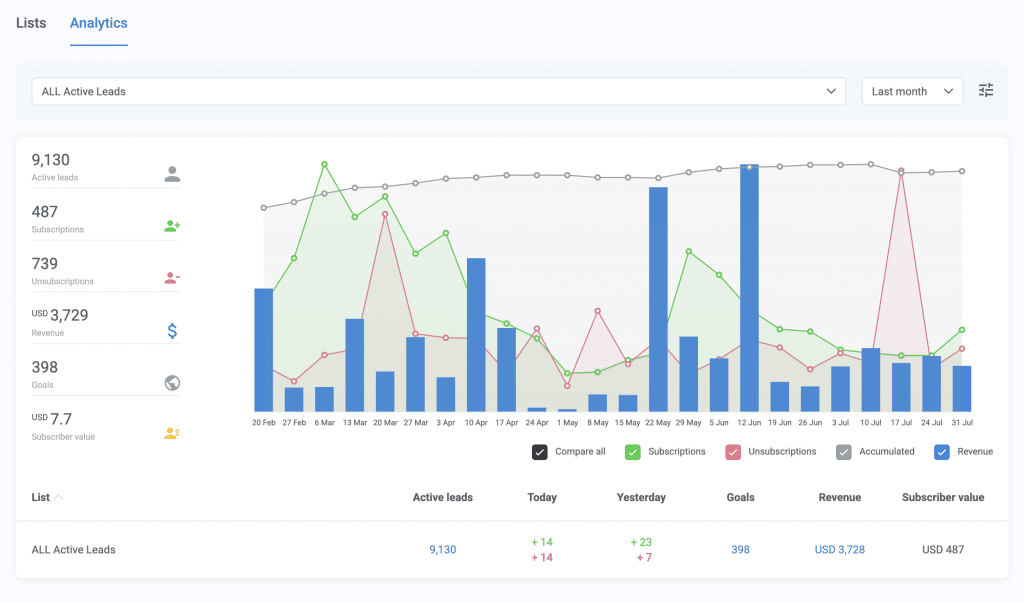
Note: this screenshot comes from my dashboard in Kartra.
July was not a month I was focused on list-building or forward-facing marketing. It was about the backend infrastructure. And we can see that here.
I didn’t do any bundles/summits in July, so the 487 new subscribers pretty much all came from ads and organic. And since we religiously prune our email list of cold subscribers every month (which keeps our open rates and deliverability high and our costs low), we actually lost more subscribers than we gained.
It’s okay. I’m not afraid of unsubscribes.
Every person who leaves wasn’t my person anyway. Every unsubscribe is someone self-selecting out of my ecosystem, which means the people who stay are more aligned with what I’m offering.
I’d rather have 500 engaged subscribers who open my emails and buy my stuff than 5,000 cold contacts who ignore everything I send. When someone unsubscribes, they’re doing you a favor—saving you money on email costs and improving your deliverability rates.
Your email provider (and your wallet) rewards you for having an engaged list, not a big one.
NOTE: Just a quick note to point out that while it’s amazing that Kartra gives us data like how much each subscriber is worth and their lifetime value, this isn’t 100% accurate for my business because we also sell through Shopify. And that isn’t counted towards these numbers.
What I Learned from Investing in Systems This Month
While everyone else was chasing viral content and quick wins, I spent July doing the unsexy work that actually scales businesses: building systems.
Not only did I make major headway on my Airtable databases (see June’s report for more details), I underwent a MAJOR tech stack migration.
Shopify to Kartra Migration
After months of thinking about it (aka procrastinating), I finally migrated my entire shop from Shopify to Kartra. Why? Because having everything in one platform means better tracking, simpler funnels, and way less tech headaches.
The migration itself was tedious (shoutout to my amazing VA, Jayce, for handling the heavy lifting), but the result is a streamlined system that saves me hours every week.
And the new 1-click upsell for MBA at $44/month is working beautifully—we saw immediate sales and have been getting almost 1 sale/day from this new funnel! Which is accruing $582 for every sale (aka more recurring revenue).
What worked: Having a hard deadline (the Shopify bill) created urgency. Delegating the heavy lifting to Jayce while I focused on strategy was the right call.
Steal this: Set artificial deadlines tied to real consequences (like recurring bills). It forces you to stop overthinking and start shipping.
Investing in Systems for Growth: AI Deep Dive
In July, my “Summer of AI” in full swing. I joined Rick Mulready’s AI Playbook membership (easily some of the best money I’ve spent in a long time!), I got incredible feedback from the Summer of AI Roundtable discussion my mastermind and I hosted, I created even more custom GPTs for my best-selling courses, and I continued using AI for everything from sales page copy and email sequences to spiritual and mental health and learning more about my ADHD family and how their beautiful brains work.
The breakthrough moment? Using AI to turn hate mail into marketing gold. When someone sent me a nasty email about using AI in my business, instead of getting defensive, I fed it to ChatGPT and asked for email angles. The result? One of my highest-converting promotional emails ever.
Steal this: Instead of fearing criticism, use it as market research and material. The loudest objections often reveal the biggest opportunities.

Ad Testing Breakthrough
After months of being terrified of Facebook ads, I finally achieved nearly 2x ROAS on my free challenge funnel. The secret? Starting small ($15/day), testing relentlessly, and viewing “failed” campaigns as data investments rather than losses.
My retargeting campaign for Get It Done Week wasn’t immediately profitable (0.82 ROAS), but the insights I gained were priceless. Now I know exactly what to tweak for next month’s campaign.
Steal this: Set aside a specific “learning budget” for ads. Treat the first few months as education, not immediate ROI.
How to Scale a Business Sustainably?
In July, I put a big focus on creating a morning and evening routine for both myself and my family with our summer camp schedules and vacations.
Those 8 solo days at home were a game-changer. I rediscovered the power of starting my day with intention instead of immediately checking my phone.
What worked: My “solo sabbath sandwich” approach—one nourishing thing, one productive thing, one soul thing—gave me structure without rigidity.
The plot twist: I realized my morning routine needed to be seasonal. Summer mornings with kids home look different than school-year mornings, and that’s okay.
Steal this: Design routines around your actual life, not your ideal life. Flexibility beats perfection every time.
How Did Strategic Spending Affect My July Results?
What’s Working: Daily Sales Without Social Media
Think of this like a checklist for what to do in your business if you want to make daily sales without social media, especially if you’re an introvert or neurodivergent entrepreneur like me!
- An Everything Page and Shopify Store.
- Low-cost tripwires on every single lead magnet, plus pop-up tripwires on every single thing I sell, with bumps and 1-click upsells on EVERYTHING!
- Creating an all-access pass/everything offer and breaking out its components into a la carte options to meet folks where they’re at
- Asynchronous coaching; Email coaching has been going AMAZING and our weekly group coaching in The Room is growing, resulting in thousands of dollars every month in recurring revenue.
- A super engaging evergreen welcome series with a 50.31% open rate and 5.59% click-from-opens rate that makes sales and leads into a weekly sales sequence for my shop that’s also converting super well.
- Sending my live weekly Sunday newsletter, “The Whole Soul List” where I make multiple offers every week while connecting with my people on a much deeper, personal level.
- And finally, I think the fact that I am a Clockwork Queen (aka I manage my time really well) and have so many efficient, automated systems in place, and take such good care of my mental health and wellbeing, all allow me to show up as my best self, maximize productivity and really feel in a creative flow with endless energy and passion for the work I do. I am so so grateful every single day that this is how I get to spend my time. I absolutely adore my job!

August 2025 Business Goals After a Low-Income Month
- Scale Ads: My Beyond the Scroll challenge funnel is finally profitable at nearly 2x ROAS, so it’s time to increase my daily ad spend from $50 to $75+ and see how far I can push it before performance drops. I’d also like to add in some ads for some of my other offers and see if I can get any ads going directly to a sales page to convert. Perhaps switch my funnel up from the daily sales webinar to lead to selling $1k/Day instead of MBA upfront.
- Continue Rolling out the New Room Retention Strategy: The Airtable data is showing me exactly when members are most likely to cancel and which touchpoints drive the highest engagement. Rachel and I need to finish consolidating the Slack channels and implement the milestone rewards system we designed.
- Update my morning routine now that kids will be back in school: With consistent childcare from 7:30-5:30 starting August 4th, I can finally design a morning routine that doesn’t get interrupted by “Mom, I’m hungry” every 10 minutes. Time to bring back the journaling, movement, and deep work blocks that fuel my best days.
- Add more customGPTs to my best-selling courses and host some 72-hour flash sales for the Summer of AI. I’m making this super low pressure… I get to what I get to and if I have to scrap some, that’s okay. This is just a fun experiment.
- Shift my focus from beginner offers toward higher-level assets for established entrepreneurs: I’ve got my lead-gen funnels set up for beginners, and I welcome them. But I want to lead more with messaging geared towards a more established biz owner. #1 plan to do this:
- Elevate $1k/Day as my marquee offer: The $1K/Day Experiment has been quietly successful, but I haven’t been promoting it strategically. I want to position this as my signature program for entrepreneurs ready to hit four-figure daily revenue through systems and passive income streams.
Want Coaching on Scaling with Systems? Join The Room for $7 for your first month ($97/month after, cancel anytime)
Get Weekly Group Coaching Calls for Accountability + Community where we can help you with all of this and more! Entrepreneurship is lonely, but you’re not alone anymore!
Final Thoughts: Is Spending to Scale Really Worth It?
July taught me that sometimes the best business months look terrible on spreadsheets. While my revenue dipped, I built the foundation for sustainable scaling.
The systems I created, the knowledge I gained, and the infrastructure I built will compound for years. That’s worth way more than a temporary profit boost.
If you’re in a similar season—investing in systems, learning new skills, or building foundations—don’t let short-term numbers discourage you. The businesses that last are built during these “boring” months.
Your future self will thank you for doing the unsexy work now.
What about you? Are you prioritizing short-term profits or long-term systems? Let me know in the comments—I’d love to hear about your own investment seasons.
If you’d like a closer look at how I make daily sales without social media, consider joining me in The $1K-a-Day Experiment for unfiltered insights and access to my evolving strategies.
FAQS: Strategic Business Investment for Entrepreneurs
What’s the difference between business expenses and investments?
Expenses cover day-to-day operations, while strategic business investments fund future growth and pay dividends over time. Investing in your business means intentionally spending on systems, tools, marketing or education that enhance efficiency, scalability, or long-term revenue. It’s not about vanity metrics—it’s about sustainability
How do I know if a business investment is worth it?
Ask: Will this save time, improve systems, or generate long-term revenue? If it creates leverage or scales your impact, it’s likely a smart investment—even if ROI isn’t immediate.
How can I scale my business sustainably?
Sustainable scaling starts with systems: evergreen funnels, automation, and offers that don’t require you to be online 24/7. It also means honoring your energy—less hustle, more strategy.
Is it normal if my income dips while investing in growth?
100%. A temporary dip in income can be a sign that you’re building foundations that support long-term growth. Strategic investments might reduce short-term profit but boost future scalability, as scaling often requires upfront costs—like software, team hires, or coaching—that temporarily reduce profit. What matters is long-term ROI, not short-term dips.
What is the $1K/Day Experiment?
It’s my transparent behind-the-scenes journey to generating $1,000/day in passive product sales without using social media—through systems, soulful strategy, and consistent evergreen marketing. Learn more here.
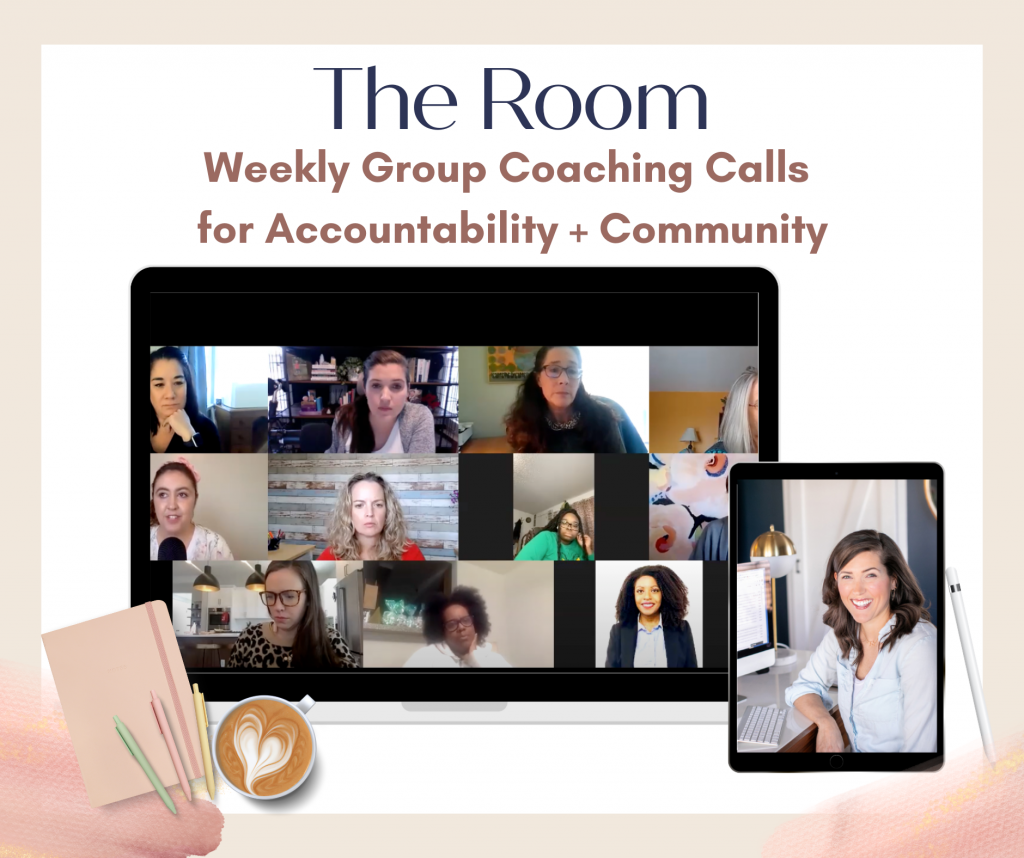
Get Your First Month in the Mastermind for Just $7!
Entrepreneurship is lonely. But you’re not alone anymore! Clients who show up for these calls get better results faster—period. Use the code ROOMFOR7.




FEELING OVERWHELMED?
There’s only one way to eat an elephant (hint: one bite at a time!) and our 30-step roadmap to starting an online business will help you check things off your to do list like a pro!
YES, PLEASE!