Learn my secrets to creating a successful online business with my holistic strategies and soulful marketing advice for heart-centered entrepreneurs who value relationships, mindfulness, spirituality and health as much as strategic action and practical tips.
LEARN MORE →




Success with Soul Incubator
Success with Soul Shop
Launch Your Dream Offer Mini Course

Our most popular posts to help you create, grow and monetize your online business with soul!
EXPLORE POSTS →
Income Reports
Passive Income
Increasing Traffic


Will AI Replace Coaches? Here’s What I Actually Think
April 14, 2026
Kate Kordsmeier





Will AI replace coaches? Short answer: not anytime soon — and the coaches panicking about it are making a strategic error that’s actually more dangerous than AI itself. Here’s what I keep telling clients who want to blow up a working business in response to a threat that isn’t quite what it looks like.

I had a coaching call recently that perfectly illustrated a pattern I’ve been seeing everywhere. The client — a fitness and wellness coach moving her practice online — came in spiraling about whether AI was going to make her irrelevant.
She was already half-pivoting to an entirely different business model. Starting to build something new. Hedging her bets.
I had to pump the brakes. Hard.
Because what she was describing wasn’t strategic planning. It was anxiety wearing a strategic planning costume.
The real threat isn’t AI replacing coaches. It’s coaches replacing themselves prematurely.
Table of Contents
Will AI Replace Online Coaches? Here’s the Honest Answer
AI will not replace coaches — in fitness, wellness, life coaching, business coaching, or any other category built on genuine human expertise, accountability, and relationship. The emotional intelligence, lived experience, and human trust that define effective coaching are among the least automatable skills in the modern economy.
Here’s what most online business owners miss: we are living inside an AI adoption bubble that our clients have not entered. We’re using Claude (Anthropic’s AI assistant), ChatGPT (OpenAI’s large language model), and Perplexity (an AI-powered search engine) every single day.
Our clients mostly haven’t. According to a 2024 survey by the Pew Research Center, only 23% of U.S. adults report using ChatGPT. Among older demographics — who make up a large portion of wellness and fitness markets — that number drops even further.
The person Googling “gentle workouts for bad knees” has not outsourced her fitness plan to an algorithm. B2C (business to consumer) markets lag B2B (business to business) markets on AI adoption by years. The people most likely to replace a coach with AI are tech workers and other online business owners — not the people who hire coaches for human connection, accountability, and lived expertise.
The Real AI Risk Isn’t Coaching — It’s the Pivot Away From It
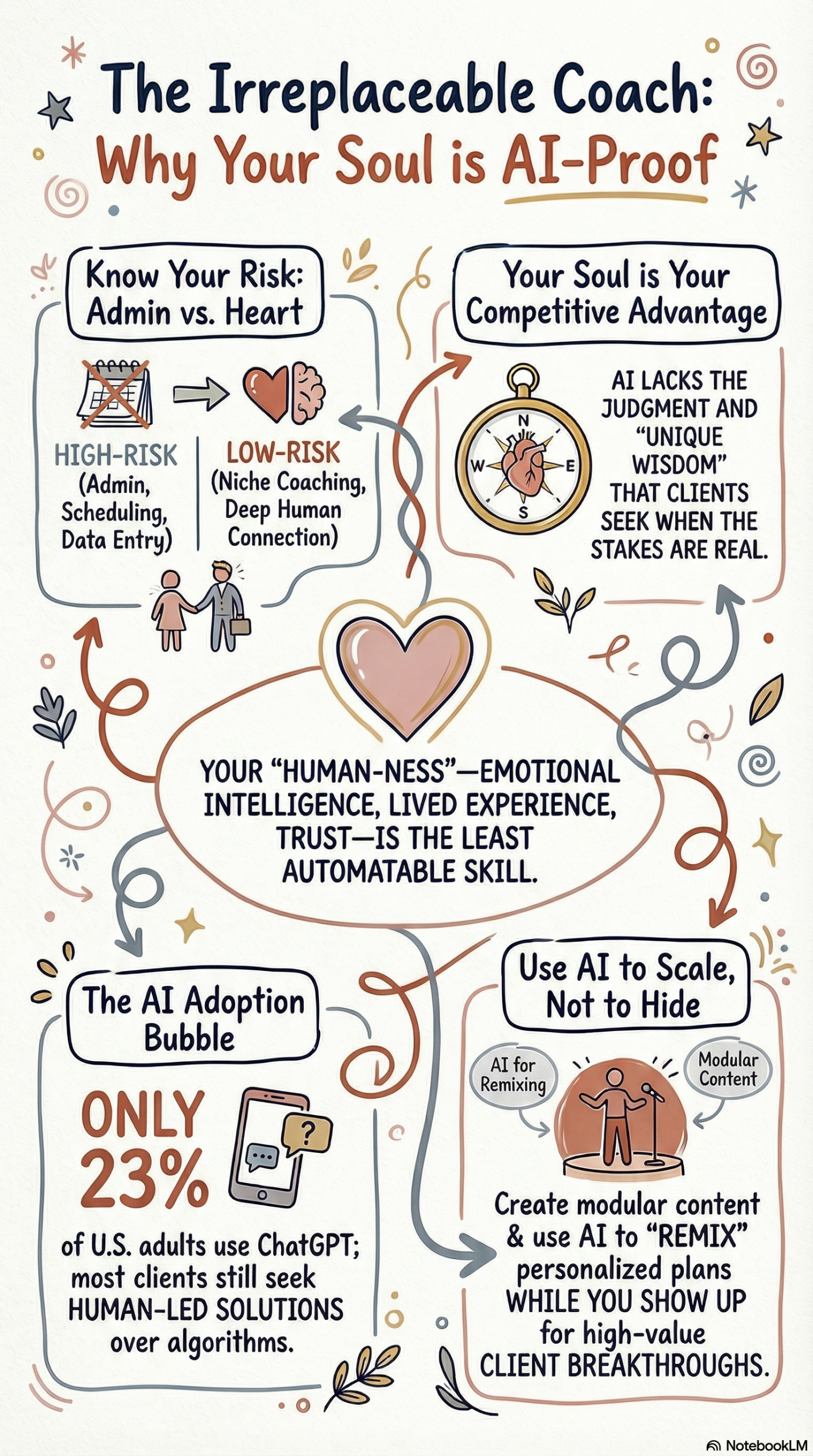
Coaching isn’t going anywhere — not B2C coaching, not B2B coaching, not any kind of coaching that involves real human expertise, accountability, and relationship. The whole category is relatively protected because what makes coaching valuable is exactly what AI can’t replicate: judgment, lived experience, emotional intelligence, and a relationship of trust built over time.
What is at risk? The work that doesn’t require a human to do it.
And this is where I see coaches making a genuinely dangerous mistake. I’ve talked to coaches who are seriously considering pivoting toward virtual assistant (VA) and admin services because they think it’s “safer” than coaching — less visible, less personal, less vulnerable. That logic has it completely backwards.
Email management, calendar scheduling, research tasks, data entry, website updates — these are already being handled by tools like Claude (Anthropic’s AI assistant), Zapier (an automation platform that connects apps), and Make (formerly Integromat). The business owners most likely to hire VAs are the earliest AI adopters, and the first to automate those tasks away.
Pivoting from coaching to admin work to escape AI is like running out of the rain into a swimming pool.
Here’s where the actual risk lives:
| Work Type | AI Automation Risk | Why |
|---|---|---|
| VA / admin tasks (email, scheduling, data entry, research) | 🔴 High — already happening | Rule-based, repetitive; tools like Zapier and Claude handle these now |
| Generic content writing | 🔴 High | ChatGPT, Claude, and Jasper produce passable first drafts at scale |
| Coaching — any kind | 🟢 Low — years out at minimum | Requires emotional intelligence, lived experience, real accountability, human trust |
| Niche/specialty coaching (chronic illness, neurodivergence, specific populations) | 🟢 Very low | Hyper-specific expertise + lived experience is irreplaceable by definition |
According to the McKinsey Global Institute’s Future of Work research, tasks requiring emotional intelligence, complex social interaction, and physical expertise are among the least automatable skill categories. Coaching hits almost every one of those.
I still see my actual therapist every week. I use AI for a lot of things — content, systems, research. But when the stakes are real and I need the advice to be grounded in genuine human expertise? There’s no substitute. Your clients feel exactly the same way about you.
The Business Model That Uses AI as a Feature, Not a Threat
The right question isn’t “how do I survive AI?” It’s “how do I build AI into my offer so it becomes a competitive advantage?”
Coaches who integrate AI thoughtfully will outpace those who either ignore it or let fear of it stall them.
My client had been filming modular workout video segments — warm-up, main block, cool-down — designed to be mixed and matched. Here’s the AI-integrated model I laid out for her:
- Build a modular content library — short video segments (5–10 minutes each) hosted on YouTube (which doubles as a free search engine and trust-building platform), organized by goal, body area, and difficulty level.
- Create a paid membership — hosted on a platform like Kartra (an all-in-one course and email marketing platform) or Kajabi (a course hosting tool with membership features) where the full library lives in organized playlists members can access anytime.
- Add an AI-powered “remix” tool — a custom chatbot (built in Zapier’s chatbot feature, or using a custom GPT trained on your content) that members check in with daily: “Here’s how I feel. Here’s what hurts. I have 20 minutes.” The AI reads the library and builds a personalized workout from segments the member hasn’t used recently, filtered by their stated goals and limitations.
The result: an offer that feels deeply personalized at scale, without requiring you to be live for every interaction. You create the content once. The AI does the remixing. You show up for the high-value human work — community calls, Q&As, coaching sessions.
According to a 2023 Grand View Research report, the global online fitness market is projected to grow at a compound annual growth rate (CAGR) of 32.9% through 2030, with AI-personalized programming as one of the fastest-growing segments. The coaches who win won’t be the ones who ran from AI. They’ll be the ones who made it part of the product.
I use a similar approach in my own business — building AI tools and automations that deliver personalized experiences to students inside the Mindful Business Academy without requiring me to be present 24/7. If you want to see exactly how I use AI to systemize and scale, my Scale with AI course walks through the whole thing.
How to Turn the Thing You’re Most Embarrassed About Into Your Biggest Competitive Advantage
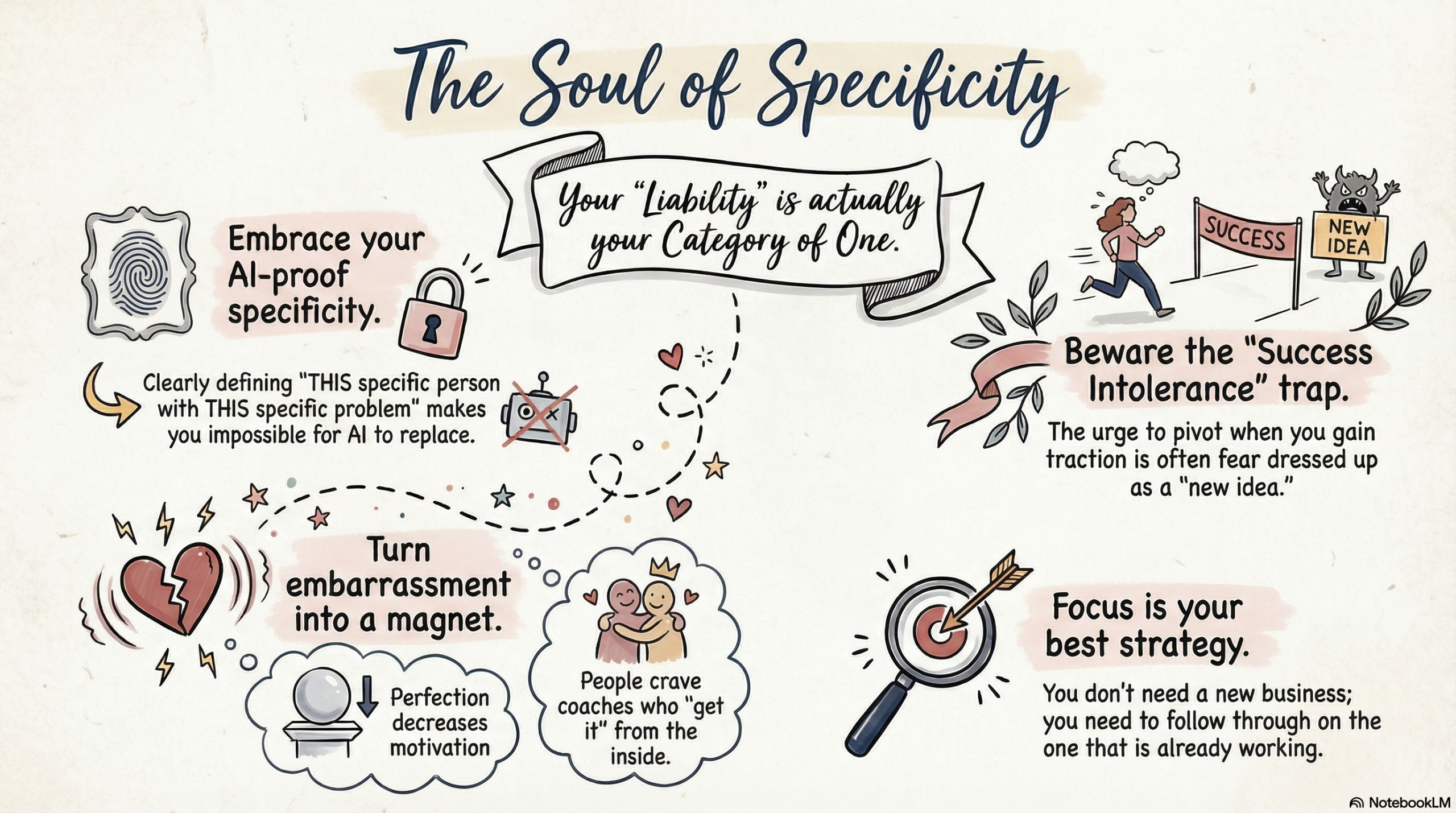
Specificity is your most powerful AI-proof asset. The more clearly you can say “I work with THIS specific person experiencing THIS specific problem,” the harder you are to replace — by AI or anyone else.
My client mentioned almost offhandedly that she was a larger-bodied fitness professional and wasn’t sure how that affected her marketability. I had to stop her there.
Because in a saturated market of fitness professionals who look like they were designed in a lab to make you feel bad about yourself, being a larger-bodied coach who works with people returning to movement after surgery, with chronic illness, with neurodivergence — that’s not a liability. That’s a category of one.
Research published in the Journal of Health Communication found that exercise content featuring exclusively thin, highly athletic individuals actually decreases motivation in people with larger bodies or chronic conditions. Your clients aren’t looking for someone who has never had to think about modified movement. They’re looking for someone who gets it from the inside.
The internet is saturated with 45-minute HIIT workouts (high-intensity interval training) from people who have never missed a sleep cycle. Five-minute modular workouts designed for real energy levels and real bodies — from a coach who has lived that — is a gap the market is actively hungry for. That’s not a niche. That’s a magnet.
What’s Really Behind the Urge to Start a New Business Right Now
When something starts working, it scares us. Not because we’re ungrateful — but because now there are expectations. Now we have to follow through. Now there’s something to lose.
I’ve seen this pattern so many times I’ve given it a name: success intolerance.
My client told me she’d gotten nearly 100 leads from a recent podcast appearance — from one interview. And instead of figuring out how to convert those leads, her instinct was to pivot to a different business in a different niche. That’s not strategy. That’s avoidance.
Success intolerance is what happens when forward momentum feels more threatening than stagnation. The most dangerous moment in building a business is right when it starts to get traction — because that’s precisely when a shinier idea appears, a “better” opportunity surfaces, and a fear whispers that this thing you’re building isn’t sustainable anyway.
If you follow that voice, you’ll spend the next five years starting things and abandoning them just before they work.
Focus is the most underrated business strategy. You don’t need a new business. You need to go back to the one that just got 100 leads and figure out what to do with them. I’ve written about this pattern in my post on counter-intuitive online business advice — the lessons that only make sense after you’ve made the expensive mistake of ignoring them.
How to Get Better at Selling Without Feeling Like a Sleaze
Selling is not a personality trait — it’s a practiced skill. And if you believe you’re “bad at selling,” what’s almost certainly true is that you’re inexperienced at it, not constitutionally broken.
The transition from giving free content to making an ask doesn’t have to be clever. It just has to be honest. “I work with people coming back from surgery or just getting started with movement. If that’s you, here’s how to work with me.” Full stop. That’s the pitch.
The reason selling feels gross is usually because we’re imagining it as manipulation. But if you genuinely believe in your offer, withholding the ask is actually the selfish move. You’re letting your own discomfort override someone else’s access to help they need.
One genuinely useful practice: use an AI tool like Claude to role-play sales conversations before you have them with real humans. Ask it to play a skeptical potential client and run through the objections — price, timing, “I need to think about it.”
A Harvard Business Review study on AI-assisted practice found that consultants using AI to rehearse scenarios finished tasks 25.1% faster with measurably better outcomes. Same principle applies to sales: you don’t get better by watching — you get better by doing. Here’s a real example of a client who built a full ads funnel in one week — because she stopped overthinking and started executing.
What One Coaching Call Actually Covers (That AI Can’t)
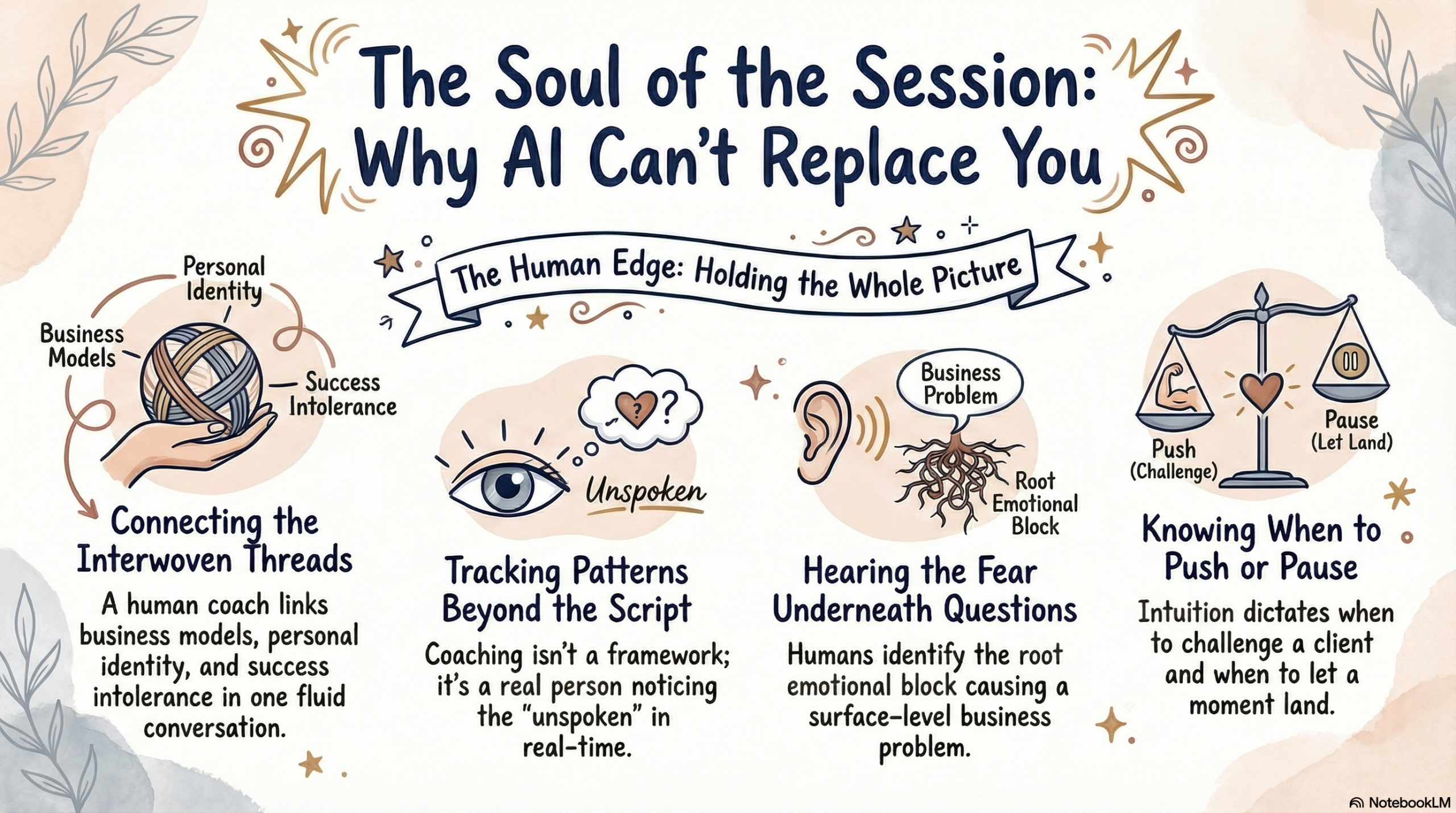
Here’s the thing about this particular coaching call that I keep coming back to: we covered an extraordinary amount of ground in one session.
We started with the AI panic. Then we moved into her actual business model — the modular video library, the membership, the AI remix tool. Then into her positioning as a larger-bodied fitness professional and why that was a feature, not a bug. Then into success intolerance and why she was considering blowing up a business that was gaining traction. Then into selling, and why her reluctance to make an ask was costing her clients who needed her.
Five distinct threads. All interconnected. All requiring someone to hold the whole picture at once, notice the patterns, name what was really happening, and redirect without judgment.
That’s what coaching is. Not a script. Not a framework applied to a situation. A real person, in real time, tracking all of it — the stated problem and the one underneath it, the stated question and the fear that generated it.
I’ve built AI tools that do a lot of things in my business. I use Claude for content, strategy, systems, and research every single day. But I have never built an AI that can do what happened in that call — because it required reading between the lines, following a thread, and knowing when to push back gently and when to just let something land.
If you’re a coach reading this: that’s what you offer. Don’t undersell it.
And if you’re someone who wants that kind of thinking partnership for your own business — the kind that moves through five different problems in one hour and leaves you with actual clarity — that’s what I do in my 1:1 coaching work. We have options depending on where you are:
- A 20-minute Voxer Unstuck Session if you have one specific thing to work through
- An Expert Eyes audit if you want personalized feedback on what’s working and what isn’t
- A full 1:1 Coaching Call if you need the whole-picture conversation
All three are things AI genuinely cannot replace — and yes, I’m aware of the irony of saying that in this particular blog post.
FAQs: Will AI Replace Online Coaches?
Will AI replace online coaches?
AI is unlikely to replace online coaches — in fitness, wellness, life coaching, business coaching, or any other category built on genuine human expertise and relationship. According to McKinsey Global Institute’s Future of Work research, tasks requiring emotional intelligence, complex social interaction, and lived expertise are among the least automatable. Pew Research (2024) found only 23% of U.S. adults currently use tools like ChatGPT. The more accurate future is AI-augmented coaching, not AI-replaced coaching.
How can coaches use AI in their coaching business without being replaced by it?
Build AI into your offer as a feature — not a competitor. For example, creating a modular content library and layering an AI-powered recommendation chatbot (built via Zapier, a custom GPT, or a platform like Coachvox) on top of it gives clients personalized experiences at scale. Tools like Claude for content drafting, Fathom (an AI meeting notes tool) for session summaries, and Kartra for automated email sequences let coaches work smarter without adding hours. AI handles the routine; you handle the relationship.
Is virtual assistant work more AI-proof than coaching?
No — and this is one of the most common misconceptions. Coaching as a category is relatively protected because it requires emotional intelligence, lived experience, real accountability, and human trust. VA and admin tasks — email management, scheduling, data entry, research — are already being automated by tools like Claude, Zapier, and Make. Pivoting from coaching to admin work to escape AI is moving toward the most automatable work, not away from it.
What is success intolerance in online business?
Success intolerance is the pattern where entrepreneurs abandon a working business strategy — or start building something new — right as their original business gains momentum. It often stems from fear of visibility, fear of failure at a higher level, or discomfort with the expectations that come with traction. It shows up as pivots, shiny object syndrome, and “strategic” overhauls that are really just avoidance. Recognizing it is the first step to staying focused long enough to actually win.
What AI tools are most useful for online coaches right now?
The most practical AI tools for online coaches in 2026 include: Claude and ChatGPT for content drafting, client communication templates, and sales conversation practice; Fathom for automatic meeting notes and session summaries; Zapier for connecting tools and automating workflows without code; Kartra or Kajabi for automated email sequences and membership delivery; and custom GPTs (built on OpenAI’s platform) for creating AI-powered client tools trained on your specific content and methodology.
The Bottom Line: Integration Beats Evacuation
The future of coaching isn’t something happening to you. It’s something you can architect around — if you stop panicking long enough to actually think strategically.
AI will not replace coaches who have real expertise, real relationships, and a specific person they serve with genuine skill. But it will create distance between coaches who integrate it thoughtfully and those who let fear make them abandon working businesses before those businesses have a chance to work.
Stay focused. Build the library. Add the AI layer. Know your specific person and speak directly to them. Practice the pitch.
And if something starts working? That’s the moment to lean in — not the moment to start over.
If you want the complete blueprint for building a coaching business on systems instead of social media — including how I use AI to deliver personalized experiences at scale — the Mindful Business Academy has every course, template, and AI tool I’ve built, for a fraction of buying them separately. Or if you want live strategy and accountability, The Room is where we dig in weekly alongside other coaches and course creators who are done building on borrowed platforms.




FEELING OVERWHELMED?
There’s only one way to eat an elephant (hint: one bite at a time!) and our 30-step roadmap to starting an online business will help you check things off your to do list like a pro!
YES, PLEASE!