Learn my secrets to creating a successful online business with my holistic strategies and soulful marketing advice for heart-centered entrepreneurs who value relationships, mindfulness, spirituality and health as much as strategic action and practical tips.
LEARN MORE →




Success with Soul Incubator
Success with Soul Shop
Launch Your Dream Offer Mini Course

Our most popular posts to help you create, grow and monetize your online business with soul!
EXPLORE POSTS →
Income Reports
Passive Income
Increasing Traffic


Why Low-Cost Tripwires Are the Smartest Way to Turn Subscribers Into Paying Customers
January 20, 2026
Kate Kordsmeier





Discover how low-cost tripwires turn subscribers into buyers, increase funnel conversions, and build long-term customer loyalty.
If you’ve been around the online business world for more than five minutes, you’ve probably heard people casually mention tripwires like everyone already knows what they are.
And if you’re anything like me, you might’ve nodded along while quietly thinking, Okay… but what does that actually mean?
When I first started hearing about low-cost tripwires, I honestly assumed they were just another buzzy marketing tactic that worked great for other people’s businesses… not something I really needed to add to mine.
Because I already had freebies. I already had solid offers. I wasn’t hurting for ideas.
What I was struggling with, though, was turning browsers into buyers. People would join my list, grab the free thing, and then… crickets. Sound familiar? That’s where tripwires quietly change the game.
They’re not about squeezing money out of people or devaluing your work. They’re about creating a first yes that feels easy, aligned, and genuinely helpful.
In this post, I want to walk you through why low-cost tripwires work so well, why a simple $7 offer can be surprisingly powerful, and how these small, intentional offers can turn casual subscribers into invested customers… without feeling salesy, pushy, or gross.
If you’ve ever wondered how to build more momentum in your business without adding more pressure or bigger launches, this might be exactly the missing piece.
Table of Contents
What Is a Tripwire? (And Why It’s Not a Gimmick)
At its core, a tripwire is a low-cost, high-value offer that someone sees immediately after opting into your email list and can only snag for a limited period of time, usually 15 minutes.
It’s usually priced low enough to feel like an easy yes (think $5–$29) but valuable enough that the buyer walks away thinking, Wow, that was actually really good.
And that part matters.
Because a tripwire isn’t about tricking someone into spending money. It’s about giving them a small, meaningful win right away. It bridges the gap between “I like your content” and “I trust you enough to buy from you.”
That first purchase, even a small one, changes the relationship instantly.
Here’s the big distinction a lot of people miss:
Subscribers and customers behave very differently.
Freebie-only subscribers often:
- Skim emails (or never open them at all)
- Stay curious but non-committal
- Wait… and wait… and wait some more
Customers, on the other hand:
- Pay attention
- Take action faster
- Are far more likely to buy again
A tripwire creates that shift without pressure. It lets someone experience your teaching, your framework, or your approach in a tangible way — without needing a long sales page or a huge leap of faith.
And no, it’s not the same thing as cheapening what you offer; it highlights your value. When someone gets real results or clarity from a small purchase, it naturally raises their perception of everything else you sell. Instead of wondering whether your bigger offers are “worth it,” they already know the answer.
That’s why tripwires work best when they’re intentional… not thrown together as an afterthought. They’re not about volume for volume’s sake. They’re about creating momentum, trust, and a smoother path into the rest of your business.
Next up, we’ll talk about why the $7 price point works so well, and how it became such a sweet spot for converting curious subscribers into confident buyers.
Who Is Sage Grayson + Why Her Tripwire Strategy Matters
Before I ever tested tripwires in my own business, I first saw them working really well in someone else’s. That someone was Sage Grayson.
If you’ve been in the online education or digital product space for a while, there’s a good chance you’ve come across Sage’s work. She’s known for building smart, sustainable funnels that don’t rely on constant launches or burnout-level hustle and one of the biggest drivers behind that is her use of low-cost tripwires.
What caught my attention wasn’t just that she had tripwires. It was how simple and intentional they were.
Sage regularly offers her courses, trainings, and resources for just $7, even if they could easily sell for much more. These products are genuinely useful, not fluff products or watered-down previews. In many cases, they’re trainings that were previously priced much higher, made available for a short window after someone joins her list or views her sales page for the first time.
And the results? Sales happening within minutes. Not weeks of nurturing. Not endless follow-up emails. Just real people saying yes because the offer feels aligned, helpful, and low-risk.
But the most interesting part isn’t the $7 sale itself.
Sage has shared how these buyers often come back to purchase higher-priced programs, bundles, and even entire catalogs of content. That first small purchase turns into trust. Trust turns into loyalty. And loyalty turns into long-term customers who actually use what they buy.
Seeing that play out made me realize something important:
Tripwires aren’t about lowering the bar. They’re about lowering the barrier to entry and that distinction changes everything.
The Magic of the $7 Tripwire
Let’s talk numbers for a minute, because this is usually where people start raising eyebrows.
Why $7? Why not $27? Or $17? Or even $5?
What I’ve seen (both in my own business and watching others do this well) is that $7 hits a really unique sweet spot. It’s not free, so it carries commitment. But it’s also not expensive enough to trigger a whole internal debate. Seven dollars is a fancy coffee. A quick lunch. A “sure, why not?” kind of purchase.
That’s exactly why it works.
When someone opts into your list and immediately sees a $7 offer that clearly solves a specific problem, it feels easy to say yes. There’s no pressure, no overthinking, and no need to bookmark it “for later.” The value is clear, the risk feels low, and the timing is right.
This is something I noticed almost immediately when I started experimenting with $7 tripwires myself. I tested offering trainings and courses that were normally priced much higher (think $44, $111, even $222) as a limited-time $7 purchase right after opt-in. And instead of hurting my sales, something unexpected happened.
People bought the $7 offer… and then came back later to buy other things at full-price.
It sounds backwards, but it makes sense when you think about it. The tripwire removes uncertainty. It lets someone experience your teaching style, your depth, and your approach before committing to a bigger investment. Once they’ve gotten results or clarity from that first purchase, paying full price later doesn’t feel risky… it feels logical.
And this is where a lot of business owners get tripped up. They worry that offering something so inexpensive will train people to only buy when things are cheap. But in practice, the opposite is often true. When someone sees how much value you deliver at $7, they naturally assume your higher-priced offers must be even better.
The $7 tripwire isn’t about undercutting your work. It’s about creating a fast, positive first experience. An experience that builds trust, confidence, and momentum right from the start.

Tripwires Are Just the Beginning
One of the biggest misconceptions about tripwires is that the $7 sale is the end goal. It’s not. It’s the starting line.
Once someone has bought from you, even just once, their mindset shifts. They’re no longer wondering if your work is “worth it.” They’ve already decided it is. That’s what makes everything that comes next so much easier.
This is where order bumps and upsells come into play.
An order bump is a small, complementary offer shown right at checkout. It’s the online business version of “Do you want fries with that?” The customer is already in a buying mindset, their payment info is already out, and the additional offer feels like a natural add-on rather than a hard sell.
What I’ve found (and what Sage has seen as well) is that order bumps convert incredibly well when they’re priced similarly to the tripwire itself. When someone is already spending $7, adding another $7 doesn’t feel like a big decision. It feels logical.
In my own funnels, I’ve consistently seen order bump conversion rates hover around 40–50% when:
- The bump solves a closely related problem
- It’s clearly explained in one or two sentences
- The price matches the original tripwire
People think, “I’m already here. This makes sense. I might as well.” And they’re right.
Upsells work in a similar way, but they go a step further. After the initial purchase is complete, the buyer is presented with a slightly higher-priced offer that expands on what they just bought. Not something random, but something that deepens the result they’re already after.
This is where tripwires quietly turn into real revenue drivers. You’re not relying on one product to do all the work. You’re creating a small ecosystem where each offer naturally leads into the next.
And the best part? None of this feels pushy when it’s done well. It feels helpful. It feels thoughtful. It feels like you actually understand what your customer needs next… because you do.
4 Reasons Low-Cost Tripwires Work So Well
Low-cost tripwires aren’t just trendy. They’re effective because they align with how real people make decisions. When done thoughtfully, they support both your audience and your business.
Here are four of the biggest reasons they work so well.
1. Kickstart the Customer Relationship
The hardest sale to make is always the first one.
A low-cost tripwire makes that first yes feel easy and safe.
When someone purchases a small offer and finds it genuinely helpful, trust is built almost immediately. You’re no longer just a name in their inbox… you’re someone who delivered real value. That experience makes future decisions easier, whether that’s joining a program, buying a course, or investing in higher-level support.
Tripwires aren’t about the money; they’re about starting the relationship on solid ground.
2. Create Real (Not Fake) Urgency
Urgency gets a bad reputation, mostly because we’ve all seen it done poorly. But when urgency is honest and intentional, it helps people make decisions instead of staying stuck in indecision.
Time-limited tripwires work because they:
- Encourage action while interest is high
- Reduce the “I’ll come back later” problem
- Feel fair when the rules are clear
When someone knows an offer is only available for a short window after opting in, they’re more likely to decide (one way or the other) instead of procrastinating.
3. Build a More Engaged Email List
There’s a big difference between a list full of subscribers and a list full of buyers.
People who purchase even a low-cost tripwire are more likely to:
- Open emails consistently
- Click links
- Pay attention to future offers
They’ve already shown they’re willing to invest, which makes your list more engaged and responsive over time. This often leads to higher conversions across the board… not because you’re emailing more, but because you’re emailing the right people.
4. Make Your Funnel Work Harder (Without You Working Harder)
Tripwires create a smoother, faster path from lead to customer. Instead of waiting weeks or months for someone to warm up, you’re delivering value immediately and inviting them to take the next step.
That means:
- Shorter buying cycles
- More predictable sales
- Less pressure on launches to “carry” your entire business
When tripwires are set up well, they quietly do their job in the background: building trust, creating momentum, and supporting sustainable growth.
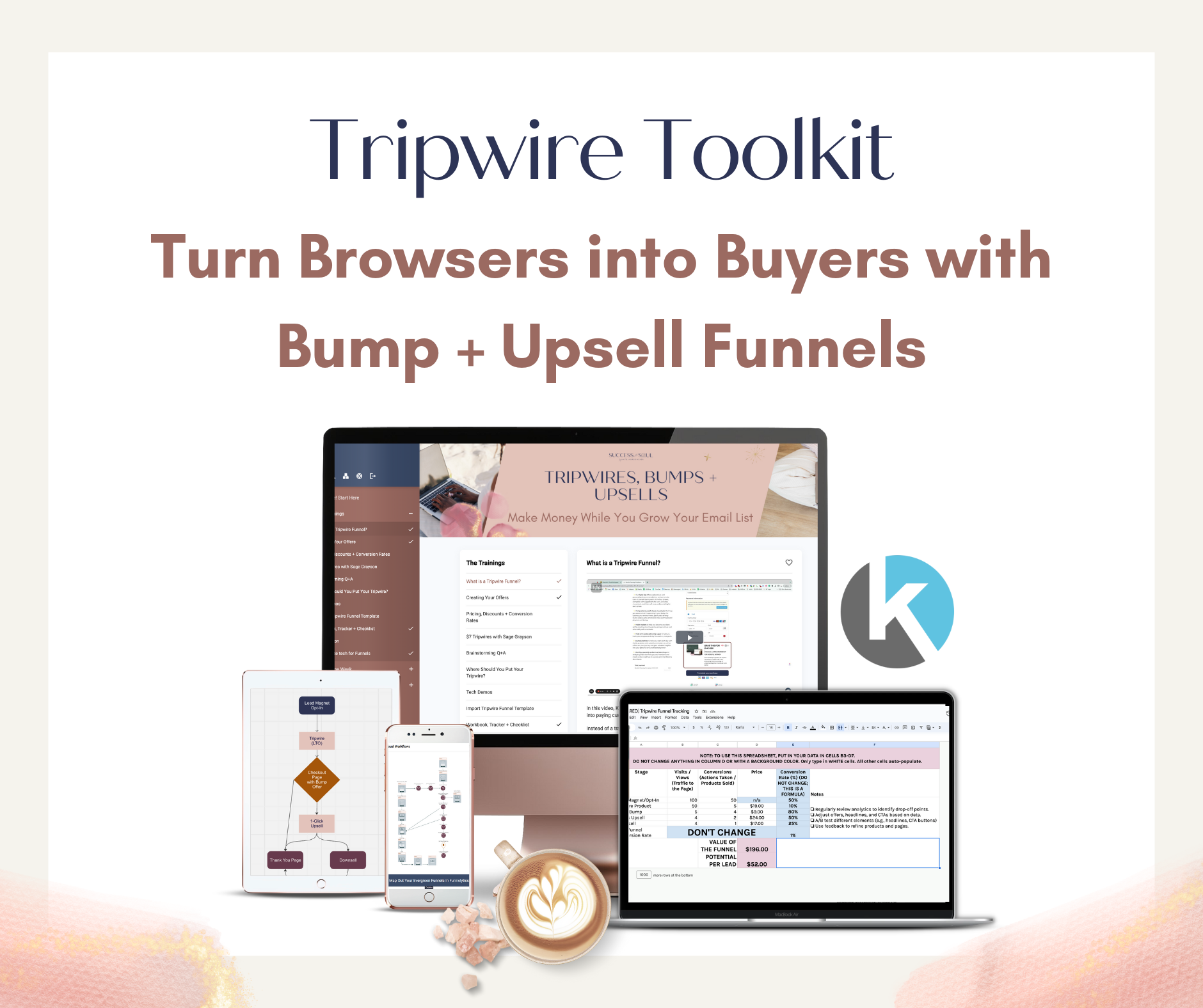
If this is starting to click but you’re thinking, Okay… I get the idea, but how do I actually do this? — I’ve been there. And that’s exactly why I created the Tripwire Toolkit.
It walks you through how to create a low-cost tripwire that actually converts, including what to offer, how to price it, and how to structure the funnel without overcomplicating things or adding a ton of extra work to your plate.
👉 You can check out the Tripwire Toolkit here
If you want a clear, doable way to turn subscribers into buyers (without burning yourself out) this is a really good place to start.
Addressing Common Concerns About Low-Cost Tripwires
Even when tripwires make sense logically, there’s often a little voice in the back of your head saying, Okay… but what if this backfires? That hesitation is normal.
Let’s walk through the most common concerns and talk about what actually happens in practice.
“Won’t Low-Cost Tripwires Devalue My Work?”
This is usually the biggest fear and honestly, it’s understandable. You’ve put real time, energy, and expertise into your work. Of course you don’t want it to feel disposable.
But here’s the truth: value isn’t defined by price… it’s defined by results.
When someone buys a low-cost tripwire and gets a meaningful win, their trust in you increases. They don’t think, “This was cheap, so her work must be cheap.” They think, “If this is what I got for $7, imagine what the bigger offers are like.”
High-quality tripwires actually raise the perceived value of your brand because they prove you deliver, even at a low price point.
“Can I Really Make Money With $7 Offers?”
On their own, $7 sales aren’t meant to replace your income. That’s not the point.
Tripwires work because of:
- Volume
- Backend offers
- Repeat buyers
Each small sale opens the door to future purchases of courses, programs, bundles, coaching, or services. Over time, those follow-on sales add up in a way that’s far more sustainable than relying on occasional big wins.
Many business owners find that tripwires create steadier cash flow and warmer leads for higher-priced offers. It’s not about making everything cheap. It’s about making the path into your business smoother.
“What If I Attract the Wrong People?”
This one surprises a lot of people, but low-cost tripwires often attract better customers, not worse ones.
Free-only audiences can be hit-or-miss. Buyers, even small buyers, have skin in the game.
They’re more likely to:
- Take action
- Respect your time
- Follow through
A well-positioned tripwire filters in people who value learning, growth, and implementation… which is exactly who you want in your ecosystem.
If you’ve ever worried that tripwires would cheapen your brand or bring in the wrong crowd, know this: when done intentionally, they tend to do the opposite.
Final Thoughts: Why Low-Cost Tripwires Are Worth Testing
If there’s one thing I hope you take away from this, it’s that low-cost tripwires aren’t about making things smaller — they’re about making the first step easier. Easier for your audience to say yes. Easier for you to build trust. And easier for your business to grow without relying on constant launches or exhausting sales cycles.
You don’t need a massive audience, a complicated funnel, or a brand-new product to make this work.
You just need a clear understanding of what your audience needs most right now and a willingness to offer that value in a way that feels supportive, not overwhelming.
Tripwires work because they respect people’s time, money, and attention. They invite commitment instead of demanding it. And when they’re done well, they create momentum that carries far beyond that initial $7 purchase.
If you’ve been feeling stuck between giving everything away for free and jumping straight to high-ticket offers, this might be the middle ground you’ve been looking for.
Get the Tripwire Toolkit
If you’re ready to stop guessing and start building a tripwire that genuinely supports your business (and your energy), I created the Tripwire Toolkit to help you do exactly that.
Inside, I walk you through:
- How to create a high-value tripwire offer
- How to add simple order bumps and upsells that make sense
- How to build a funnel that works quietly in the background
No fluff. No pressure. Just a clear path to turning new subscribers into paying customers.
👉 You can grab the Tripwire Toolkit here
You don’t need to do everything at once… you just need a smart, supportive place to begin.
Frequently Asked Questions About Low-Cost Tripwires
What is a tripwire in online marketing?
A tripwire is a low-cost, high-value offer shown immediately after someone opts into your email list. Its goal is to turn a new subscriber into a first-time buyer quickly and naturally.
Why are $7 tripwires so effective?
The $7 price point feels low-risk while still creating commitment. It’s enough for someone to take the purchase seriously, without triggering hesitation or long decision-making cycles.
Do tripwires work for service-based businesses?
Yes. Tripwires can be workshops, audits, templates, mini-trainings, or resources that support your service and lead naturally into higher-touch offers.
Will tripwires devalue my higher-priced products?
No — as long as the tripwire delivers real value. In most cases, it increases trust and makes higher-priced offers easier to say yes to later.
How long should a tripwire offer be available?
Many successful tripwires are time-limited (for example, 15–30 minutes after opt-in). This encourages action while interest is high, without relying on fake urgency.
Can I use tripwires without running launches?
Absolutely. Tripwires are especially powerful for creating consistent, everyday sales that don’t depend on launches or big promotions.




FEELING OVERWHELMED?
There’s only one way to eat an elephant (hint: one bite at a time!) and our 30-step roadmap to starting an online business will help you check things off your to do list like a pro!
YES, PLEASE!