Learn my secrets to creating a successful online business with my holistic strategies and soulful marketing advice for heart-centered entrepreneurs who value relationships, mindfulness, spirituality and health as much as strategic action and practical tips.
LEARN MORE →




Success with Soul Incubator
Success with Soul Shop
Launch Your Dream Offer Mini Course

Our most popular posts to help you create, grow and monetize your online business with soul!
EXPLORE POSTS →
Income Reports
Passive Income
Increasing Traffic


The Hidden Cost of Being the Bottleneck in Your Business (And How to Fix It Without Burning Out)
March 3, 2026
Kate Kordsmeier





If you feel overworked and stuck, you might be the bottleneck in your business. Learn how to scale sustainably without burning out.

I realized I was the bottleneck in my business on a random Wednesday afternoon… while staring at my ClickUp board and feeling vaguely resentful.
There were three tasks waiting on my approval. Two contractors had sent “just circling back!” messages. A funnel update was half-done because I hadn’t reviewed the copy yet. And I could feel that low-grade hum of pressure in my chest that whispers:
If you would just sit down and focus, everything would move.
And that was the problem.
Everything only moved when I moved.
If I was tired? It stalled.
If I was overwhelmed? It stalled.
If I decided to take a day off and sit on the porch with a chai latte pretending I don’t own a business? You guessed it — stalled.
For a long time, I told myself this was leadership. High standards. Brand integrity. Excellence.
But if your business slows down every time you do… that’s not leadership.
That’s a bottleneck.
And if you’re a smart, capable, high-functioning woman who built her business from scratch? There’s a very good chance you’ve become one too.
Not because you’re bad at business or because you “can’t delegate.”
But because no one teaches us the difference between being the operator of a business… and being the architect of one.
In this post, I want to talk about the hidden cost of being the bottleneck in your business. We’ll cover what it’s actually doing to your growth, your team, your nervous system… and how to shift out of it without burning everything down or losing control.
Because you are not meant to be the machine.
You’re meant to design it.
Table of Contents
What Does It Mean to Be the Bottleneck in Your Business?
Let’s define this clearly, because “bottleneck” sounds like something that happens in traffic — not in a well-run, color-coded, Asana/ClickUp/Notion-organized business.
A bottleneck in your business happens when growth, progress, or decisions are delayed because everything has to go through you.
Every approval, tweak, decision, or “quick question.”
On paper, this can look like leadership.
In reality, it often looks like this:
- Your team can’t move forward until you review something.
- A launch is ready… but stalled because you haven’t signed off.
- Emails sit in drafts because you want to “look at them one more time.”
- You’re rewriting work that was already 90% done.
- You take a week off and suddenly everything slows down.
If your business can’t run at least partially without your constant input, that’s not empowerment.
That’s a founder bottleneck.
And listen… I say this with love because I’ve lived it.
When you build something from scratch, you become the nervous system of the entire operation. You know how everything works. You’ve touched every funnel, every offer, every sales page, every customer support email.
Of course it feels safer to keep your hands on it.
But here’s the subtle shift:
There’s a difference between being essential to your business… and being the single point of failure.
One is visionary leadership.
The other is unsustainable control disguised as excellence.
And if you’re exhausted but also quietly proud that “nothing runs without you,” I want you to gently question that pride.
Because a business that depends entirely on your capacity will always be limited by your capacity.
And that’s not scaling.
That’s survival mode in a cute outfit.
Why Smart Entrepreneurs Become the Bottleneck
Here’s what makes this tricky:
It’s usually not the disorganized, chaotic, “throw spaghetti at the wall” business owners who become the bottleneck.
It’s the competent ones.
The capable ones.
The ones with high standards.
The ones clients describe as “so on top of everything.”
If you’re reading this, I’m guessing that’s you.
And that’s exactly why this sneaks up on you.
1. You’re Really Good at What You Do
You built this thing from scratch.
You wrote the first sales page, figured out the email platform, stitched together the first funnel with duct tape and vibes…
Of course you know how to do everything.
When you’ve been the copywriter, tech VA, strategist, designer, launch manager, and customer support rep… it feels faster to just do it yourself.
And in the beginning? It is.
But what makes you efficient at $10K months becomes what caps you at $50K months.
Because when everything lives in your head, nothing scales beyond your head.
2. Perfectionism Disguised as “Standards”
This one stings a little.
You tell yourself:
- “I just have high standards.”
- “I care about quality.”
- “I don’t want it to sound off-brand.”
And all of that can be true.
But underneath that can also be:
- Fear of being misunderstood
- Fear of disappointing your audience
- Fear of looking less competent
- Fear of losing control
So you tweak the caption, rewrite the email, redo the Canva graphic, or “just quickly fix it” instead of teaching someone how to fix it next time.
And suddenly you are the quality control department… forever.
Excellence is beautiful.
But when excellence becomes a nervous system regulation strategy? That’s when it becomes a bottleneck.
3. Your Identity Is Wrapped Up in Being Needed
This is the part most of us don’t admit out loud.
There is something deeply validating about being indispensable.
When:
- Your team can’t move without you
- Your clients rely heavily on you
- Your business depends on your brain
It feels important, powerful, and like proof that you matter.
But there’s a shadow side to that identity.
Because if you are the only one who can move things forward… you also carry the full weight of keeping everything alive.
That’s not leadership.
That’s pressure.
4. Overfunctioning Is a Trauma Response (Not a Business Strategy)
Especially for women, eldest daughters, and people who grew up being the responsible one.
Overfunctioning looks like:
- Stepping in before someone fails
- Fixing things that aren’t technically your job
- Mediating issues that don’t belong to you
- Taking on emotional labor automatically
In business, this shows up as:
- “I’ll just handle it.”
- “I’ll clean it up.”
- “It’s easier if I do it.”
Until one day you realize you’re exhausted… and also the reason nothing runs without you.
And I say that with so much compassion.
Because becoming the bottleneck isn’t a character flaw.
It’s usually a pattern that once kept you safe.
But what kept you safe at the beginning of your business might now be what’s keeping you small.
The Hidden Cost of Being the Bottleneck
At first, being the bottleneck feels productive.
You’re busy, involved, and you’re “on top of everything.”
But the cost of being the bottleneck in your business doesn’t show up immediately.
It shows up slowly. Subtly. Expensively.
1. Your Growth Slows (Even If You’re Working More)
If every decision requires you…
If every task waits for you…
If every launch pauses until you approve it…
Then your business can only move at the speed of your personal energy.
And last I checked, we are not robots.
We get tired, have kids, get sick, have hormonal cycles, want white space, and we need days where we’re not “on.”
When you are the bottleneck, your revenue is directly tied to your capacity.
That’s not scaling.
That’s self-employment with prettier branding.
2. Your Team Stalls (And Eventually Stops Caring)
This is the part people don’t talk about.
High-performing contractors and team members do not enjoy waiting.
They want:
- Clear direction
- Autonomy
- Trust
- Momentum
If they constantly have to check with you, projects stall because you haven’t reviewed something, or if feedback takes days…
Eventually one of two things happens:
They disengage.
Or they leave.
And when strong team members leave, it’s rarely about money.
It’s about friction.
3. Your Creativity Gets Crushed
When you’re stuck in:
- Reviewing graphics
- Editing small tweaks
- Answering repetitive questions
- Making micro-decisions all day
You don’t have energy left for:
- Vision
- Big-picture strategy
- Innovation
- New offers
- Experiments
You become the executor instead of the visionary.
And here’s the irony:
You probably started your business because you’re a visionary.
But bottlenecking turns visionaries into managers of tiny details.
That’s not your highest use.
4. You Create a Revenue Ceiling You Can’t See
This one is subtle but powerful.
If your business requires your constant hands-on involvement to function…
Then your income is capped by:
- Your available hours
- Your mental clarity
- Your emotional bandwidth
There is only so much you can personally approve, review, tweak, and rewrite in a week.
You might still be making good money.
But there’s a difference between:
“I’m making money.”
And:
“My business can grow without consuming me.”
A bottleneck doesn’t just limit your output.
It limits your future.
5. Your Nervous System Never Fully Rests
This is the hidden cost no one measures.
When everything depends on you, your nervous system never truly stands down.
Even when you’re off, on vacation, or even out to dinner.
There’s always that quiet hum:
“If I don’t handle it, it won’t move.”
And over time, that hum becomes exhaustion.
Not because you’re weak.
But because you were never meant to be the entire infrastructure.
Being the bottleneck isn’t a moral failure.
It’s often a sign that you’ve outgrown your current operating model.
And the beautiful thing about that? It means you built something real.
Now it just needs a new structure to hold the next level.
Operator vs. Architect: The Identity Shift That Changes Everything
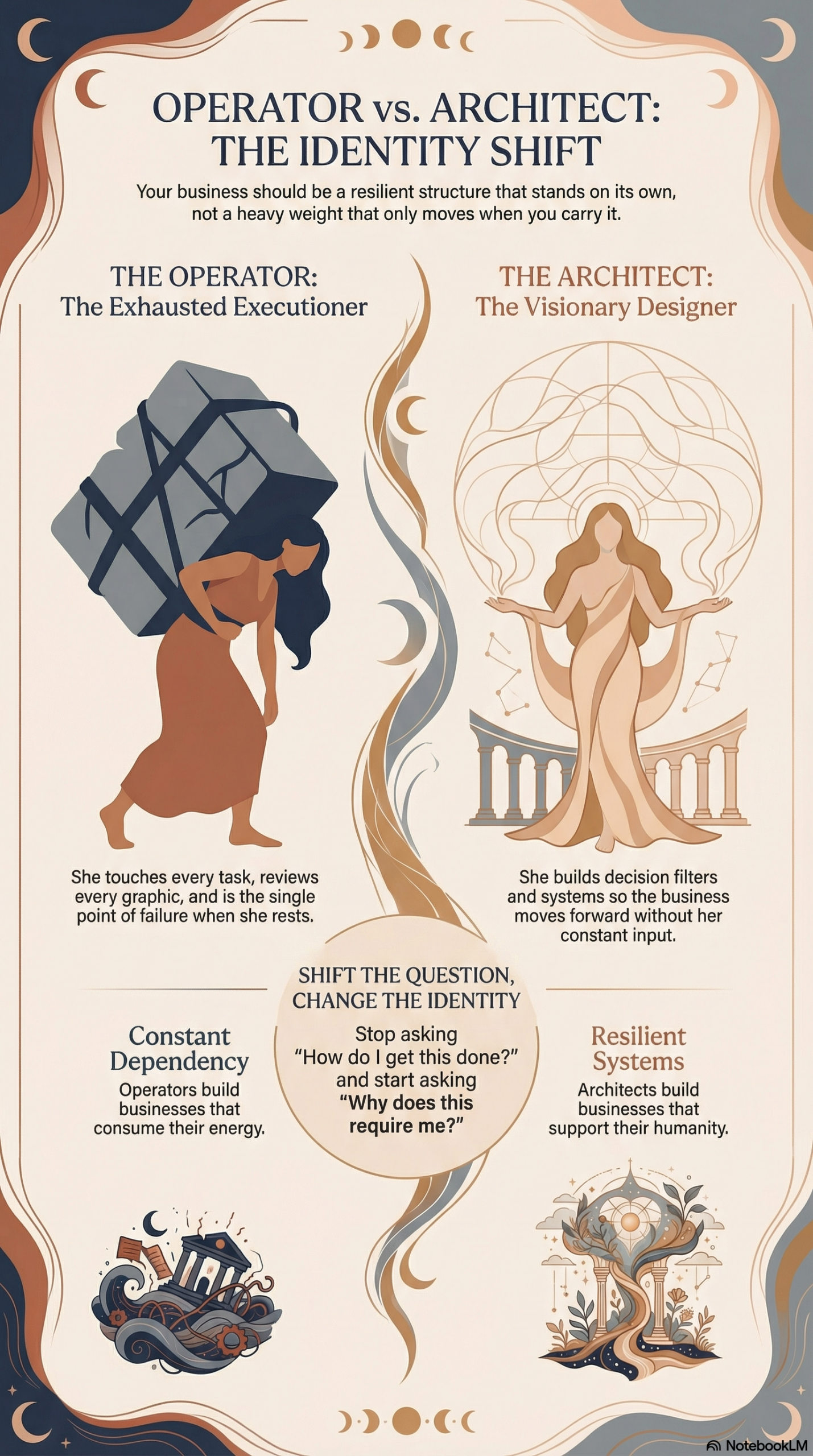
Here’s the reframe that changed everything for me:
The goal is not necessarily to work less.
The goal is to operate differently.
There are two roles every founder moves between:
The Operator and the Architect.
And most bottlenecks happen when we never graduate out of Operator mode.
The Operator
The Operator touches everything.
She:
- Writes the emails
- Reviews the graphics
- Fixes the funnel
- Answers the DMs
- Adjusts the pricing
- Tweaks the copy
- Handles the tech glitch
- Rewrites the SOP
She is capable, competent, and efficient.
And she is tired.
The Operator lives inside the day-to-day execution of the business.
She is in the weeds.
And in the early stages? That’s necessary.
But here’s the problem:
If you stay in Operator mode forever, your business will only grow as fast as your hands can move.
The Architect
The Architect designs the system the Operator works inside.
She:
- Builds decision frameworks
- Defines brand filters
- Creates approval standards
- Documents processes
- Designs offers intentionally
- Builds systems that repeat
She doesn’t ask:
“How can I get this done faster?”
She asks:
“How can this get done without requiring me every time?”
The Architect protects her energy not because she’s lazy… but because she understands that her highest value is vision, direction, and strategy… not micro-edits.
The Subtle (But Radical) Shift
When you move from Operator to Architect, you stop asking:
“How do I keep up with everything?”
And start asking:
“Why does everything require me?”
That question alone will change your business.
Because often the issue isn’t workload.
It’s design.
If your team constantly needs your approval, you likely don’t have clear decision filters.
If launches stall without you, you likely don’t have documented processes.
And if you feel indispensable, you likely haven’t built repeatable systems.
None of this means you’re doing it wrong.
It means you’ve reached the ceiling of your current operating model.
You Don’t Have to Disappear to Scale
This is important.
Becoming the Architect does not mean:
- Removing yourself from your brand
- Becoming cold or corporate
- Delegating your voice
- Outsourcing your genius
It means designing infrastructure that supports your humanity.
It means building a business that can move forward even when:
- You’re tired
- You’re on vacation
- Your kid is sick
- You’re in a creative lull
- You want to think instead of react
Architects build businesses that are resilient.
Operators build businesses that are dependent.
And if you’re reading this, I’m guessing you’re ready for resilient.
How to Stop Being the Bottleneck in Your Business (Without Burning Everything Down)

Let me be very clear:
You do not need to overhaul your entire business overnight.
You don’t need to fire your team, create a 72-page SOP manual, or become some hyper-detached CEO caricature.
You just need to start redesigning intentionally.
Here’s where I’d begin.
1. Create Decision Filters (So Everything Doesn’t Require You)
Most founders become bottlenecks because they are the only decision-maker.
But the real issue? The decision criteria only exists inside your head.
Instead of: “Send it to me and I’ll review it.”
Try: “If it meets these 3 standards, ship it.”
For example:
- Does this align with our brand voice guide?
- Does it include a clear CTA?
- Does it match the offer positioning we defined?
If yes? It goes out.
You don’t need to approve everything.
You need to define what “approved” means.
That’s Architect energy.
2. Document Once, Delegate Forever
Every time you say: “I’ll just fix it this time.”
Pause.
Because that’s how bottlenecks get reinforced.
Instead:
- Record a 5-minute Loom walking through what you changed.
- Write a short checklist.
- Create a simple SOP (not perfect — functional).
Documentation doesn’t need to be fancy. It just needs to exist.
The goal is not perfection.
The goal is reducing repeated dependence on you.
3. Embrace 80% Done
This one hurts a little.
But if your team delivers something at 80%…
And your instinct is to make it 100% yourself…
Ask:
Will that extra 20% meaningfully impact revenue or results?
Or is it soothing my anxiety?
Your version might be cleaner.
Sharper.
More “you.”
But your time is not infinite.
Sometimes shipping at 80% is what creates the momentum that actually moves the business forward.
4. Use AI as a First Pass, Not a Final Authority
AI can be incredibly helpful in removing bottlenecks… if you use it wisely.
It can:
- Draft first versions
- Organize messy ideas
- Summarize data
- Clean up formatting
- Spot inconsistencies
But you still:
- Set the strategy
- Define the positioning
- Make the final call
AI reduces friction.
It doesn’t replace leadership.
Used well, it can remove you from repetitive tasks, so you can stay in visionary mode.
5. Protect White Space Like It’s a Revenue Strategy (Because It Is)
Architects think.
Operators react.
If your calendar is full of calls, Slack pings, approvals, and micro-decisions…
You don’t have time to design.
Try:
- No-call days
- Batching reviews
- Dedicated “vision” time
- Turning async whenever possible
White space isn’t laziness.
It’s strategic capacity building.
6. Ask This Question Weekly
This one is simple but powerful:
“What moved forward this week without me?”
If the answer is nothing…
That’s your signal.
Not to panic. Not to shame yourself.
But to redesign one small piece of infrastructure.
One system, delegation, filter, or documented process.
You don’t exit bottleneck mode in a single leap.
You exit it through consistent architectural thinking.
You’re Not Failing. You’re Evolving.
If you saw yourself in this post, please hear me:
Being the bottleneck doesn’t mean you built your business wrong.
It means you built it well enough that it’s now outgrown your original operating style.
And that’s a beautiful problem to have.
You don’t need to disappear from your business.
You just need to stop carrying it.
Design the container.
Set the standards.
Build the systems.
Trust the structure.
Your job is not to be the machine.
Your job is to design it.
Final Thoughts: You Were Never Meant to Carry It All
If you’ve built a business where everything depends on you, I want to say something that might surprise you:
That’s not a flaw.
It’s proof that you’re capable.
You’re smart.
You’re resourceful.
You care deeply.
You’ve been willing to figure things out when no one handed you a blueprint.
Of course your business runs through you.
You built it that way.
But what got you here isn’t always what will take you further.
There comes a point in every business where hustle stops being the growth strategy… and design becomes the growth strategy.
Where working harder doesn’t create expansion. But thinking differently does.
You don’t need to disappear from your business.
You just need to stop being the only structural support holding it up.
Because here’s the truth:
A business that collapses when you rest isn’t freedom. It’s dependency in disguise.
And I know you didn’t build this so you could become its most exhausted employee.
You built it for flexibility. For impact. For income that supports your life, not consumes it.
So this week, don’t ask:
“How can I get more done?”
Ask: “What would need to exist so this moves without me?”
One system, filter, documented process, or delegated decision.
That’s how bottlenecks dissolve.
Not with drama.
With design.
Need More Support?
If you’re realizing you’re ready for that next layer of structure… the kind that supports your humanity instead of draining it, there are two ways I can help.

If you want ongoing support, live coaching, accountability, and strategic eyes on your business while you redesign it from Operator to Architect, The Room is where we build that infrastructure together. It’s not just mindset. It’s systems, execution, and real feedback in real time.
And if your biggest bottleneck is that everything lives in your head — your workflows, your voice, your processes — then Back Office Bot Squad will help you build AI assistants and custom systems that work like you (so you don’t have to touch every single task yourself). It’s how you stop being the first and last stop for everything.
You’re meant to be the architect of your business.
And architects don’t carry buildings.
They design them to stand.
FAQ: Bottlenecks, Scaling & Sustainable Growth
What is a bottleneck in a business?
A bottleneck in a business occurs when one person or process slows down progress, limiting growth and efficiency. For many small business owners, the bottleneck isn’t a system — it’s the founder. When every decision, approval, or task must go through you, your business can only move as fast as your capacity allows.
How do I know if I’m the bottleneck in my business?
You might be the bottleneck in your business if:
– Projects stall until you review them
– Your team constantly waits for your approval
– You rewrite or redo most delegated work
– Nothing moves forward when you take time off
– You feel indispensable… and exhausted
If your business slows down every time you do, that’s a strong sign you’ve become the bottleneck.
Why do founders become bottlenecks?
Founders often become bottlenecks because they’re highly competent and deeply invested in their brand. Perfectionism, control, identity attachment, and overfunctioning tendencies can all contribute. What starts as high standards can quietly turn into unsustainable dependence on the founder.
Can a small business scale if the owner is the bottleneck?
Not sustainably. If the business depends entirely on the owner’s time and energy, growth will eventually plateau. Scaling requires systems, documentation, delegation, and decision frameworks that allow progress without constant founder involvement.
What’s the difference between an operator and an architect in business?
An operator focuses on execution — doing the tasks, fixing problems, and managing details.
An architect focuses on design — building systems, creating processes, and defining standards so execution can happen without constant oversight.
Scaling without burnout requires shifting from operator to architect.
Does delegation mean losing control of my business?
No. Healthy delegation means building control into systems instead of carrying it in your nervous system. When you define decision filters, document processes, and clarify standards, your business can maintain quality without requiring your constant involvement.




FEELING OVERWHELMED?
There’s only one way to eat an elephant (hint: one bite at a time!) and our 30-step roadmap to starting an online business will help you check things off your to do list like a pro!
YES, PLEASE!